Are actual authentic jerseys too much to ask for?

The executives with Reebok and Nike certainly know what they’re doing. The same can be said for those who control apparel pricing in the NFL and NHL.

Go into any team store, Dicks or anywhere else that team apparel is sold and you will likely need to extend your student loans just to purchase a jersey. That is if you’re a jersey kind of guy. Personally, I’ve never gotten down with wearing jerseys to a game. I feel awkward when I’m in it and there is also the impending threat of a trade or free agency sending your player out of town. Blank jerseys are obviously safer, but not nearly as meaningful as one that looks like the duds worn on the field or rink.

Not technically authentic.
An NHL fan is going to spend roughly $150 for a replica uniform and well north of $300 for an authentic sweater from the NHL. Football fans have a similar financial burden. There are three options that range in terms of quality and price from $100, $135 and $300 each.

Perhaps the biggest drawback for buying an NFL jersey is that fact that your cheapest option is little more than a $100 mesh t-shirt with screen printed numbers. The secondary product is closer in form to what is seen on the field and the authentic jerseys have all the bells and whistles as the on-field product (to a certain extent). Continue reading

Building on the Sabres’ Canadian exploration

The Sabres have officially begun their Canadian Bacon mission of an invasion of Ontario. The goal isn’t to litter, but to establish a greater footprint for the organization in the golden horseshoe.

Ted Black, Danny Gare, Jay McKee and Ville Leino all took a trip through Ft. Erie and St. Catharines  that included visits to schools, hockey clinics and, naturally, Tim Hortons. Good on the Sabres for seeing the comedy in having Leino serve up donuts much like he did last season (see what I did there). Social Media Sam deserves some credit for her Ricky Bobby “I’d love to sign your baby” Instagram caption as well.

All kidding aside, the Sabres have taken a wise approach here. Obviously there are a ton of fans in Ontario that are ticket holders. While most of them either sell their tickets to fans of other teams or simply root for the Leafs, the Sabres have a significant portion of their patrons in Ontario. The same goes for the Bills, the Galleria and Buffalo Niagara Airport and most of Western New York.

Pulling from Ontario would occur even if the Sabres (and Bills) didn’t bother marketing themselves. It is just how sports fans will operate. For fans in Fort Erie and St. Catharines who don’t have a pro team in their city, having the Bills and Sabres a hop and a skip down the Q is beyond convenient. While Toronto is the obvious first choice for many of these fans, Buffalo provides a natural fit for sports fans looking to affiliate with an NHL or NFL franchise.

From a business standpoint, cultivating this fanbase and maybe even building upon it is an easy approach for the Sabres. What has changed is the proactive approach the team has begun to show. This type of physical outreach shows that the Sabres don’t just respect the contingent of fans they have from Ontario, they want to grow that fanbase.

This relationship could potentially have a positive effect on the rest of the Western New York sports scene as well. Continue reading

Amerks seeing red for 2012-13

While Jhonas Enroth’s mask tweet was rather unexpected, the Amerks third jersey unveiling was scheduled ahead of time. In addition to their white home and royal road jerseys, the Amerks will wear a screaming red alternate uniform this season.

Amerks.com


They did it right, however. The uniform remained unchanged aside from the base color. The triple stripes on the sleeves and waist stay blue and white and the Amerks crest also sticks around. Aside from incorporating an alternate color, the Amerks kept their jersey largely unchanged.

Perhaps it is that red, white and blue are a pleasing scheme that can be used in any combination. The Sabres use of gold doesn’t necessarily allow for too many subdued uses. While a red uniform isn’t conservative (hello, butter knives), it complements the color scheme the Amerks use quite well. Gold, on the other hand, contrasts the Sabres (or Preds) use of navy in a much louder fashion. Yet, I’m left wondering if the Sabres third jerseys (due for 2013-14) will use gold as a primary color. Continue reading

Jhonas Enroth’s stunning new mask

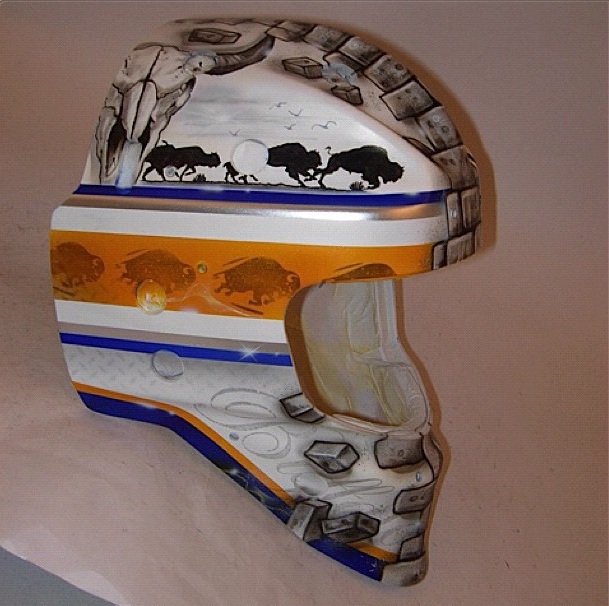
Jhonas Enroth, king of Instagram, has a new mask for the upcoming (hopefully) season. It happens to be totally awesome.

Enroth uses the world’s best helmet artist, Dave Gunnarsson (daveart), and has yet to disappoint with any of the artwork he has worn during his time in North America. His newest lid is a thing of beauty, perhaps the best helmet he will wear at this point in his career.

The brick wall art remains down the middle of the design with the Sabres primary logo prominent on the left side. On the right side is a combination of the jersey stripe form the white uniform, silhouettes of bison, Buffalo scripted on the chin and a badass longhorn skull.

Aside from providing the most vivid, sharp artwork on a mask, Gunnarsson’s specialty is working stripe patterns into his masks. This instance makes the blue, silver and gold stripes a focal point of the right side despite being the most basic portion of the artwork.

The buffalo from the primary logo adorns the gold stripe while silhouetted bison run above the upper blue stripe. Gunnarsson also worked a diamond plate pattern near the chin. However, the longhorn skull does it for me. Despite being relatively obscured towards the top of the helmet, it reminds me of a mask once worn by Grant Fuhr during his time here. That mask that Fuhr wore was my favorite Sabres mask of all time.

Combining this mask with the white bison helmet that Ryan Miller will wear ought to give the Sabres the best one-two punch of helmet artwork in the league.


Conjecture department: Could a lockout benefit the Sabres?

Might this lockout be a good thing? Not for the game or fans, mind you; but for the season.

When I look at the Sabres past few seasons, there has been a significant lull in performance at some point. Whether that came at the beginning of the year (2010-11) or in the middle of the year (2011-12), the team has suffered from a drop off that ultimately cost the team wins and position in the standings.

Obviously last year’s mid-winter slump was centered around injuries and horrible play, but fatigue and the grind of the season likely had something to do with it. Since it seems as if a lockout is inevitable at this point, could it be somewhat beneficial for the Sabres to play a shortened schedule?

Perhaps a shortened season would allow for Buffalo’s offensive players to stay fresh over the entire course of the season. The same would go for the goaltending and defense. In fact, shortening the schedule could be massively beneficial for Ryan Miller, whose workload would potentially go from 60+ games to 40+ games. That is, of course, if Lindy Ruff utilizes Jhonas Enroth properly.

There are a few permutations here that serve as counterpoints to this train of thought. First, a shorter schedule would also cause the league to condense games into a smaller package in hopes of keeping the 2012-13 season to an adequate length. This will cause more back-to-back matchups and could potentially create more wear and tear on the players.

Secondly, every team will be playing a shorter schedule. Because of that, every team will reap the same benefits from trimming the schedule down from 82 games. It’s not as if the Sabres are tailor-made to sprint as opposed to finishing a marathon or gaining any sort of added advantage compared to the rest of the league. Continue reading

Pegula Ice Arena progressing towards completion

This is a special guest submission from Kyle Rossi who runs the blog Thank You Terry. His blog is all about Penn State hockey – both club and NCAA – and is full of phenomenal information. I highly recommend reading it on a regular basis. Kyle was kind enough to offer some insight to the progress being made on the Pegula Ice Arena down in State College. Given the Sabres recent victory regarding the Webster Block, I thought there would be no one better to provide some insight on the scope of a Pegula funded project such as the PIA or the HARBORcenter. Enjoy.

Hey Sabres fans! My name is Kyle Rossi, and I write Thank You Terry, a blog covering the soon-to-be four hockey teams representing Penn State (men’s and women’s NCAA, men’s and women’s ACHA). As I’m sure you know, you and I both share a debt of gratitude to one rather wealthy man: Terry Pegula.

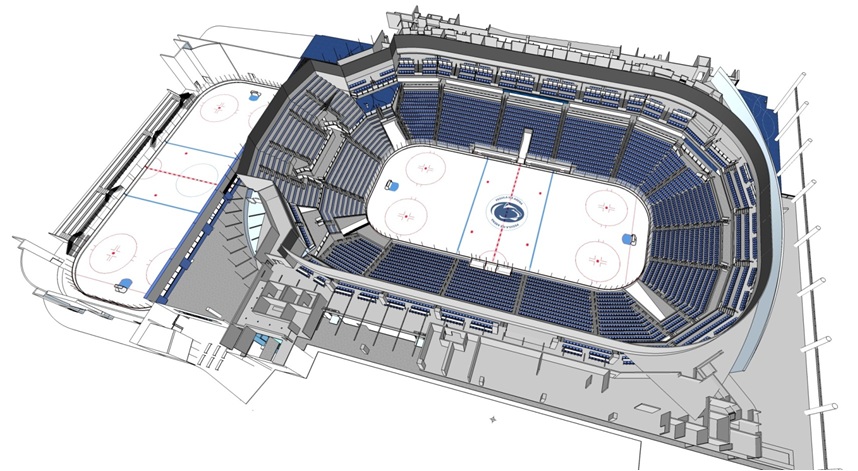
The rendering of what the finished Pegula Ice Arena will look like.

Our stories are actually somewhat parallel. While Buffalo was wandering through a purgatory characterized by an always-competitive team that never saw a free agent it couldn’t lose (or a scouting department it couldn’t slash) and therefore couldn’t take the final couple of steps, Penn State was dealing with its own sort of limbo. Our non-varsity teams, known as the Icers and Lady Icers, had been considered candidates to make the jump to the big time, NCAA Division I, for decades – if only the school could find some money for a DI-caliber hockey arena. Despite PSU’s glut of success in the ACHA (including seven national championships), the program’s rabid supporters were always just one “hey, when are you guys going DI?” from an outsider away from a feeling of hopelessness.

Suddenly, in swoops this billionaire nobody had ever heard of to write large checks and save the day. In the Sabres’ case, I suppose he wasn’t a complete unknown, but there still had to be a “wait…this guy’s a Sabres fan…and he wants to buy the team?!?” moment for you guys.

Anyway, Chris invited me to write this post to update you on the progress of something possibly of interest of you, the arena bearing Pegula’s name on Penn State’s campus.

You might be familiar with some of the widely-reported basics. There will be two NHL-sized sheets, one in what’s being called the Community Rink, which will have 300 seats, the other in the main arena, which will seat 6,000. Five thousand of those seats will be arranged in a single-level horseshoe, with a ring of suites above the open concourse that will be at the top of the “regular person” seating. The final thousand seats will be the student section, to be located behind the net Penn State will attack twice. It will be as steep as code allows, helping to meet the one major directive Pegula has given on the project, that the building “sound like a hockey game inside of a garbage can” on game days.

“It should sound like a hockey game inside a garbage can.” Terry Pegula

The price tag – $89 million – is absolutely staggering for a college hockey facility of its size. For context on that, one only needs to consider some of the venues toured by a Penn State contingent (including Pegula) in 2010 to generate design ideas. Notre Dame’s Compton Family Ice Arena, which opened last season, cost about $50 million. Miami’s Goggin Ice Center cost $35 million (in 2006). Minnesota-Duluth’s AMSOIL Arena opened in late 2010 at a cost of $38 million, while RIT’s proposed Gene Polisseni Center, the most likely candidate to replace the Pegula Ice Arena as the newest in college hockey, is estimated to cost around $35 million. Basically, if Penn State gets anything approaching dollar-for-dollar value on this project, it will instantly become the crown jewel of college hockey. Continue reading

Sabres Harbor Center chosen for the Webster Block

It is official. The development team led by Terry Pegula and the Buffalo Sabres has been selected to develop the Webster Block.

Work can now begin on the HARBORcenter project that won the bid process for the Sabres’ group. When finished, the building will include parking, a hotel, two ice rinks along with retail and restaurant space. Their official proposal tabbed March as the start of construction, which is the date the Sabres will stick with.

News reports indicate that the restaurant, retail, ice rinks and parking will be ready for the start of the 2014-15 season with the hotel to follow shortly after. With the ground breaking set for March, I would anticipate that significant process will be occurring late in the summer of 2013.

Coupled with the progress on One Canalside (Donovan Building), the faux canals and the rest of the Aud Block, the Canalside footprint will suddenly be awash with construction projects. For a district that stayed afloat on renderings and proposals, this is a breath of fresh air.

The choice of the HARBORcenter over and Carl Paladino’s proposal likely came down to the office component that was part of the Paladino project. With the HSBC tower set to be largely vacated, there was no need for over 100,000 square feet of new office space so close to what is soon to be a vacant tower. In addition, the year-round draw that will come from the ice rink component makes HARBORcenter an extremely viable project.

In addition, the inclusion of Tim Horton’s and New Era as retail partners in the HARBORcenter plans showed that the retail component is going to have an immediate impact. Hearing the word “destination” attached to the Tim Horton’s location is particularly intriguing. I know one source pointed to this as potentially being built as the world’s largest Tim Horton’s.

One thing that should be noted is that this project was kept out of the hands of ECHDC. Byron Brown wanted to keep this as a city parcel and fast track the development and did just thatNot to denigrate the work that has been done by ECHDC at Canalside, but that project has has run into its fair share of snags, holdups and setbacks over the past few years. So much so that all that can be shown for the development of Canalside are a few plush lawns and some colorful chairs. Even one of the lawns came courtesy of Terry Pegula.

Before Donn Esmonde takes the time to credit the slower, dumber, cheaper approach that is being taken at Canalside, realize that lawn chairs have nothing to do with this project. This was a parcel that was identified as prime for major development and the city didn’t settle for anything less. So, if you see some form of rhetoric touting the Adirondack chairs and their influence on this project, realize it is bull crap.

What should be pointed out is that the relationship that HARBORcenter and Canalside will have is definitely going to be give and take. Canalside, while devoid of permanent attractions and activities, draws massive crowds every summer. Once the compressors are active in the canals, it will be a year-round destination. The throngs of people that frequent Canalside will be happy to find accessible parking and real, sit down food options at HARBORcenter. On the other hand, those planning on heading to HARBORcenter for hockey or a meal will be lucky enough to stroll down to the waterfront and take in everything that Canalside has become.

Adding Tim Horton’s and New Era brings the first real private retailers to Canalside’s doorstep along with a full-scale sit down restaurant. Add in the restaurant space at One Canalside and there will be a trio of restaurants (Liberty Hound) just outside of FNC set to serve fans and participants of youth or adult hockey games. Then, of course, there are the hotel patrons that will be staying in either HARBORcenter or One Canalside.

These hotel rooms will serve out-of-town travelers, hockey families and a number of other directly in the heart of downtown near what is now becoming one of the more exciting areas of the city.

There is a ton of positive momentum building at Canalside. Some of it has come from the ancillary installations that have been put in in lieu of any concrete development over the past five years. However, today’s announcement welcomes a second full-scale piece of development that will serve as a true cornerstone for the district.

Choosing HARBORcenter may have been a difficult decision to come to, but it most certainly was the right conclusion to reach.

Poll: What are your thoughts on the All-American Prospects game uniforms?

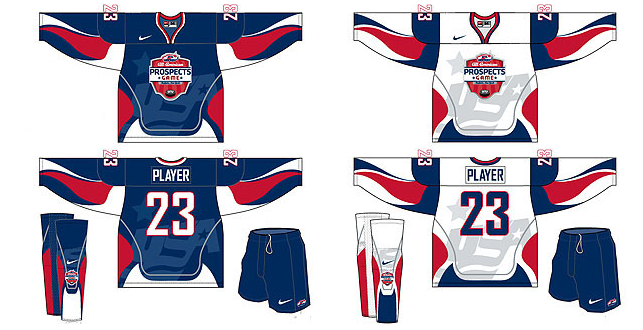
USA Hockey released the design of the uniforms for the All-American Prospects game that will be played at First Niagara Center on September 29. The uniforms, designed by Nike, have quite a bit going on. To say the least.

I don’t hate them. In fact, the white looks pretty sharp thanks to the red and blue accents. However, the blue uniform has a nice Pro Beach Hockey, RHI, minor-league feel to it. I think the watermark/sublimated USA Hockey logo that is set to the background of each pops more on the blue uniform, making it a little more busy. My only question is in regard to Nike making the jerseys for a CCM sponsored event. I know there are whispers of some hockey companies (CCM, Reebok, The Hockey Company etc.) being purchased. I just wonder if this represents one of those deals.

But enough about what I think. Share your thoughts in the comments and on the poll below.

The Instigator Podcast 1.18 – Featuring Die by the Blade

Eric and I were joined by Zach, from Die by the Blade to talk about the Sabres Alumni Golf Tournament, Shane Doan, the leadership void in the locker room and plus/minus.

Thanks again to Zach for coming on the show, he is the first official guest we have had on the Instigator and it was fun to have him in the conversation. You probably already read Die by the Blade, and if you don’t you should start doing so immediately.

What makes you elite?

The word elite gets tossed around a lot by hockey fans and members of the media. It seems to be one of those terms that is easy to use to qualify a player’s talent level when discussing career potential or, more often, their trade value.

But is there a way to draw the line on elite players? Is there a specific number that represents the cut off between elite and very good players? Or perhaps the term is so arbitrary that it is nothing more than an adjective that provides a simple way to quantify certain players.

Is Rick Nash elite? Prove it.

What is interesting about determining “elite” players is that the qualifications seem to change every season. Not to mention the fact that those who fall into the “elite” category change on a regular basis.

There is a group of players at every position in the NHL who deserve to be called elite, or superstars. However, with this term being used so loosely, I wonder if the opinion of elite status is a bit skewed.

There is no doubt that players like Shea Weber, Sidney Crosby and Henrik Lundqvist are elite. Whether you’re talking centers, defensemen, wings or goaltenders, there is a magic number of true elite players and those who fall into other categories. It is my opinion that this is not only a sliding scale on a yearly basis but based on position as well.

Perhaps the league’s elite goaltenders fall somewhere in the 7-10 range, whereas an elite defensemen could potentially be found anywhere from the 15-20 range depending on how the players were ordered and, of course, depending on who is doing the ranking.

The issue is that there is no way to truly draw a line between “elite” and “not elite”. The gray area leaves room for debate (which is fun) but also makes the term rather arbitrary. Continue reading