Looking back at the Draft: 2004

This will be the first in a series of posts that revisits the first round of the NHL Draft. I did something similar with previous Sabres drafts for Buffalo Wins last year and NHL Network Radio on SiriusXM has been doing something along these lines the last few weeks.

I wanted to look back on the first round of recent drafts and to figure out which players worked out, who turned out to be a sleeper and who wound up as a bust. So I took each draft between 2004 and 2009 and re-selected the first round based on the players from the entire draft.

I evaluated and drafted by following a handful of guidelines. The overall goal was to identify where some prospects would be picked if the draft could be reconducted today. I attempted to strike a balance of simply reordering the top 30 players from each draft and making some selections based on who would best aid certain teams.

I didn’t consider each and every team’s draft strategy since I can’t speak to the draft strategy of each team in any particular draft. However, if there was a player that would address a very specific need, goaltenders being the best example, that was taken into consideration. I also looked at each draft independent of those in the preceding or following years. A player’s original draft selection didn’t factor into their new position in this practice.

The first draft I chose to reevaluate was 2004. This draft was headlined by Alex Ovechkin and Evgeni Malkin. As you’ll notice, I will list the team’s new pick first followed by the pick they made originally with a brief explanation for most, if not all of the choices. I will also list where the new pick was originally selected.

Continue reading

Isles take another step towards keeping 2014 pick with Halak trade

The move that sent Jaroslav Halak to the Capitals was one that ensured Tim Murray ensured that he had a goaltender who would be with the organization past this summer’s free agency period. Little did many know that Halak would wind up becoming a contributing factor in which first round pick the Sabres receive from the Islanders.

Halak was swapped by the Capitals for a fourth round pick yesterday in a move that gives the Islanders two full months to negotiate with Halak ahead of free agency. This is a move geared towards improving the Islanders now. Their lack of goaltending last year kept the Islanders from competing for a playoff position and ultimately pushed them towards the top of the draft. While this isn’t a final piece of a Cup run puzzle it’s certainly a move that indicates that Snow won’t be taking the scenic route towards reshaping the roster.

That route likely includes using their 2014 first round pick.

There’s still the possibility that Halak chooses to test the market despite the Islanders efforts to get in him ahead of time – remember, the Islanders failed to get Christian Ehrhoff under contract after trading a fourth round pick for his rights in 2014. Should that be the case Snow would be stuck pursuing a contingency plan in net. Either way, it’s obvious that he wants to make immediate improvements to his roster which tells me they aren’t necessarily in the tanking business for 2014-15. Continue reading

How 2ITB voted in the 2014 PHBA Awards

A few weeks back I was contacted by PumperNicholl from The Royal Half about participating in the first annual Professional Hockey Bloggers Association awards voting. They put together 65 blogs (65!) to vote on the seven big awards.

Each blog was given one entry to select up to five players for each award. Here’s how the voting played out:

Hart Trophy: Sidney Crosby

Norris Trophy: Duncan Keith

Vezina Trophy: Tuukka Rask

Selke Trophy: Patrice Bergeron

Calder Trophy: Nathan MacKinnon

Lady Byng: Ryan O’Reilly

Jack Adams: Patrick Roy

I strongly urge you to head over to The Royal Half and look at the full voting results. The guys at TRH deserve a ton of credit for getting so many blogs together to vote and managing to find 65 bloggers who were able to get all the positions correct.

Here’s how I voted for each of the awards: Continue reading

Spitballing the Sabres: Creating a Sabres Fantasy Camp

In the past you’ve read posts on this site titled as pipe dreams. They were a string of ideas I had envisioned for various parts of the city that featured a wide range of ideas which varied in terms of feasibility.

I hope that this post serves as a starting point for a number of different ideas that I’m pitching for the Sabres. In fact, I’ve ran some similar posts in recent weeks and months. So it’s not as if this is a foreign concept to this space.

So I kept brushing him back.

Perhaps one of these ideas will strike a chord with a member of the Sabres front office (unlikely) or even just drum up conversation amongst the fan base that could gain momentum down the road. I enjoy coming up with various ideas and floating them for conversation. Especially when it’s something that could benefit the city or, in this case the Sabres.

The Sabres currently hold an annual event called the Corporate Challenge that is a three-on-three tournament that features alumni headlining teams sponsored by local businesses. The cost per team is $3500 and the players receive a jersey along with a number of other amenities that accompany the tournament. This includes food and drink throughout the day and at the culmination of the event. It’s a terrific even and I’d like to see the Sabres build on the success and momentum of the Corporate Challenge by instituting a fantasy camp. Continue reading

Proposing a change to the NHL series format

There’s no question that the NHL Playoffs are the greatest part of every season. An easy argument could be made that the postseason tournament is the best amongst the four major sports. The series format, structure and seeding are nearly perfect with the change back to the divisional format this season.

While there isn’t a thing I’d change about the playoffs in their current form, I’ve wondered recently about an adjustment to the series structure. The idea shuffles the order in which the games are played to not only add value to home ice advantage, but to give the higher seed an extra opportunity to clinch a series on home ice.

The NHL model, as it stands now follows a 2-2-1-1-1 format with the home team hosting games one, two, five and seven. It is far superior to the NBA’s awful, horrible, no good 2-3-2 order that sees the higher seed forced to the road for three straight games. The system that I’m proposing would see the lower seed host the first two games while giving the higher seed four of the final five games. Continue reading

Sabres have an arsenal of first and second round assets

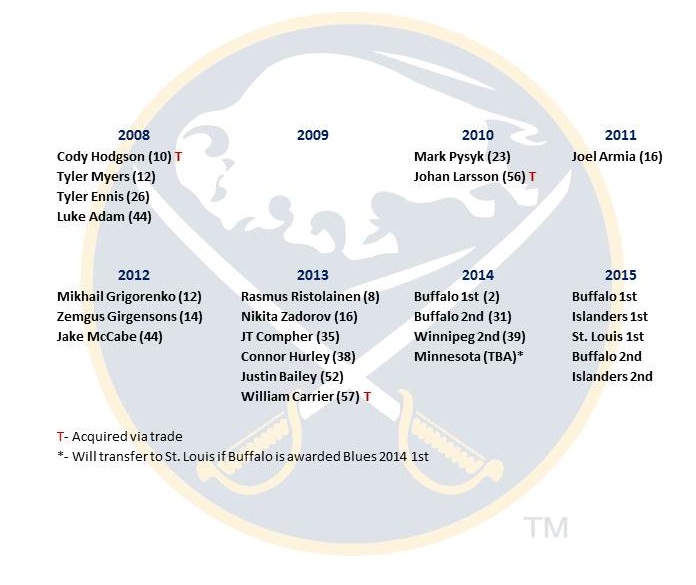
If you read Paul Hamilton’s post on WGR 550 today you may have noticed the bevvy of players he referenced. A great many of those were selected in the first two rounds of the draft (as he mentions). After reading his post I wanted to find a way to illustrate exactly what the Sabres hold from the actions they’ve taken over the last few years.

The Sabres hold nine picks in the first and second round of the next two drafts. After the trade deadline the Sabres had sixplayers selected in the first two rounds of last year’s draft. Should the Sabres hold onto all of their picks and not make any trades involving players selected since 2008, the Sabres will close the 2015 draft with 25 players in the system who were selected in the first two rounds of the draft between 2008 and 2015.

That’s a long look at the organization as anyone selected since 2008 are beyond prospect status at this point and there’s no way to tell what Tim Murray’s strategy will be with the pick he possesses between this year and next. It’s a safe bet to say that he won’t sacrifice any of the three firsts he holds next year with his only course of action regarding the 2015 first round being to obtain more selections.

A pair of picks that I’m very interested in are the two at the top of this year’s second round. Buffalo holds the first pick of the second round (31) and Winnipeg’s selection (39)thanks to the deadline day trade of Matt Moulson. They’re high second round picks in what is considered a weak draft, so they may not carry all that much weight. I also think that targeting Thatcher Demko with the 31st pick could be a direction the Sabres go. I’d also be interested to see if either, or both, of those picks could be used to sweeten the pot on a draft day hockey trade if Murray is able to find a dance partner.

What I think is important to keep in mind about this – Hamilton touches on this when he refers to how envious other organizations are of the Sabres – is that the doom and gloom surrounding the state of the organization is somewhat misplaced. The Sabres have a ton of assets and while those selected prior to 2010 may by closer to veteran than prospect status, the organization’s roots run deep. This is not a team that has been spread thin by buying rentals and temporarily patching weak spots. While the holes in the current roster run rampant, the framework to fix them are in hand and will start to be acquired as soon as June 28.

As I said, I wanted to illustrate the arsenal of high picks and assets Hamilton mentioned in his post. The fun starts at the draft in Philly and will continue through to next season. If used properly, the assets listed below could significantly speed up the rebuild. 1st two round

Who is the Next Captain of the Sabres?

The Sabres have a bunch of questions that need to at least begin to be addressed this offseason and next season. While everyone focuses on the draft and who is going to put the puck in the net for last year’s worst offensive team, many have forgotten that the Sabres are (once again) without a captain.

There are a couple basic things that I believe the organization should (or should not) do when considering who will be the next person to wear the “C”.

First (and most important) is that the next captain must come from in-house. The cons far outweigh the pros when it comes to naming a player who was just acquired as the captain. The most obvious issue is that it places undue pressure on the new player. No matter the age or experience of a player, when someone is traded to a new team, or signs with a new team as a free agent, they want to make a good first impression. On top of trying to fit in with new teammates and a new system on the ice, the player is faced with trying to acclimate to a new city off the ice. Throw in moving a family and all that comes with it into a new town and the player is juggling all he can handle.

Another concern is that naming a player that is new to the team as a captain is an indictment of the leadership qualities (or lack thereof) of your current roster. By giving the captaincy to a newly acquired player you’re basically telling the 23 guys on your roster, “I don’t think any of you are capable enough or ready enough to assume responsibility for this team.” Given the state of the Sabres’ roster, I’d advise against doing that. Continue reading

2014 2ITB Sabres Awards

The Two in the Box awards are back yet again for another year and I’m joined in the voting by the newest contributor to the site, Tyler Roeder. Tyler will be chipping in with posts here and there to hopefully increase the content on the site above the current level, which is not very much at all. Each of the players or topics we picked are represented for each category. We didn’t agree on every one but each viewpoint is included below the winners.

Most Valuable Player – Tyler Ennis

Chris: In a lost season with few redeeming qualities, Tyler Ennis recaptured some of the magic he and Drew Stafford shared at the end of the 2011-12 season on his way to leading the Sabres in goal scoring. After a year in which his value began to be questioned, Ennis came back with an impressive run that could cement his value moving forward.

Tyler: Ennis was able to win me over with his play late in the year, after nearly losing me with some Maxim Afinogenov-esque play in the middle portion of the year. Ennis was able to put up a respectable 11 points in 20 games after the team was gutted at the trade deadline.

Least Valuable Player – Ville Leino

CO: Allow me to take the easy way out with this choice. Leino was a ghost for nearly the entire season and punctuated the punchline he had become by going scoreless on the season. He put only 38 pucks on net this year, fewer than such offensive dynamos like Mike Weber, Henrik Tallinder and Matt Ellis. His time in Buffalo has been nothing short of a disaster and his inevitable buyout will rid the team of a failed attempt at buying their way to a contending roster.

TR: What else can be said at this point? When you make $4.5 million and get outscored by John Scott, you get the LVP. It’s safe to say that this year was final year (Thank God) of the Leino era in Buffalo, which is best for both parties.

Top Prospect – Rasmus Ristolainen

CO: Ristolainen almost doesn’t qualify for this award considering he appeared in 34 games this season. He did, however, justify his draft position and set himself up to be a cornerstone on the Sabres’ roster for the next number of years.

TR: The Sabres have steadily stocked the prospect pool over the last few years, and have done so with a focus on the blue line. The 6’ 4” Finn got a taste of the NHL this year, but was better served being in Rochester. While with the Amerks he put up nearly .67 pts/gm; and with the 19 year old only growing stronger and more experienced, the sky is the limit. It’s a strong bet he’ll start next season with the big club. Continue reading

Sabres still in a position of power despite losing lottery

Given that the Sabres had a 75% chance of not winning the draft lottery last night, there shouldn’t be much surprise or disappointment in Buffalo receiving the second overall pick. My disappointment lies in the two posts I wrote on Monday that needed to be drastically altered because of the result.

The consensus on this year’s draft is that the top four or five prospects are at a level above most others in the draft. This also happens to be a draft that will differ from the last two or three that preceded it in that there is no clear cut favorite to be picked first overall. Rather, the top four or five players are the consensus favorites to be selected at the top with the rest of the first round being described with any number of synonyms for average.

While the Sabres missed out on having their pick of the litter, they’re truly not at a disadvantage having to pick second. In fact, you could argue that they’re in a better situation but I’m not about to try and justify why not picking first could possibly not be the best possible scenario. I will say that the Sabres are not hamstrung for not having won the lottery. Perhaps the best possible scenario would have seen the Islanders win the lottery, but having the Panthers leapfrog the Sabres won’t have a resounding affect on the direction the Sabres go with their selection.

It would appear as if Barrie defenseman Aaron Ekblad, Kingston forward Sam Bennett and Kootenay center Sam Reinhart have established themselves as the top three prospects in the draft. Although Leon Draisaitl is considered to be right there with Reinhart and possibly even Bennett at the top.

Tim Murray repeatedly said that he is going to take the best player available regardless of position. Reading those tea leaves could point you in a number of different directions. While the Panthers aren’t guaranteed to take a particular player, the Sabres decision won’t be altered at two. In fact, the Sabres could very well end up with the exact player they wanted at one even after the Panthers pick, something that Murray confirmed last night. Continue reading

Thoughts on changing the NHL Draft Lottery

As the talent at the top of the NHL Draft continues to rise each year the topic of tanking to ensure higher odds at the first overall pick is becoming a hot topic. While the current system is designed to give the 30th place finisher the best opportunity to pick first, there is a better chance that team picks second given the odds.

With next year’s draft featuring a pair of generational talents at the top of the prospect pool, rumors and chatter have abounded regarding change to the lottery system in hopes of curbing the practice of tanking.

There doesn’t seem to be a good system that is strictly based off the order of finish in the standings. The system floated by Elliotte Friedman a few weeks back included a few nuances that wouldn’t only decrease the 30th place finisher’s chances but take into account a number of seasons as opposed to the one that had just passed.

However, it’s a fairly nuanced system that points towards even more complicated and convoluted systems for determining the first overall pick while preventing teams from taking nosedives to the bottom of the standings.

One idea I’m particularly fond of is a version of something similar I heard on NHL Network Radio a while back. If I’m not mistaken the original thought came from Mike Brophy, so direct the appropriate praise to him for the genesis of this idea.

The plan would be to still reward the worst teams with the highest picks in each year’s draft. You can’t have parity and turnover within the league unless you follow such a pattern. It also ensures that bad teams will improve – or should improve if you’re the Oilers – by picking high. In a league driven by revenues, perennial basement dwellers will eventually see lots of red ink if they can’t bring in players to overhaul their roster.

My plan would include the league’s five worst teams – although this could be expanded if necessary – in a competition to determine who wins the first overall pick. I stress the term win because this would be a standings-based competition that would be evaluated on each team’s performance after a certain point in the year. This way you can’t simply hit the brakes on your year, sell off your assets and wait to see what the lottery balls do for you once the season wraps. Meanwhile, if you finish 30th you’re still assured to draft high enough to get some help. Continue reading