On the night of the debate, Eric and I get heated on a few topics. Namely, the pending CBA, the lack of red and black and a few other topics during plus/minus.
Buffalo Sabres
Hasek statue should follow the French Connection
Friday was supposed to be a truly impressive evening. Combined with the home opener for the Buffalo Sabres, the team would also unveil the centerpiece of the new alumni plaza with the French Connection Statue.
With the end of the lockout nowhere in sight, the home opener has been cancelled. But the statue unveiling will go through as planned and it should still serve as a wonderful way to honor three of the franchise’s greatest players.

From the very brief and obstructed view I got of the statue, it looks impressive. All three players are prominently featured and the layout should provide a unique view from just about any angle. Depending how the structure will be lit, I expect that the statue will be very impressive at night.
The next step will be identifying who else will join the French Connection in the plaza. Thanks to this week’s news, the next addition should be Dominik Hasek. Continue reading
The Instigator Podcast 2.2 – Locked Out
The lockout is indeed on. While the CBA arguments went beyond the September 15 deadline, regular season games have now been cancelled and this has become a very real thing. Eric and I sat down to discuss the lockout, solutions for it and a host of other topics. We tackle the Alumni Plaza and, of course, play a little plus/minus.
All the Kings Men
Jessie Cohen and The Royal Half both invited me to guest on their 30 NHL bloggers from 30 NHL teams in 30 nights mission. I was lucky enough to have them ask me to be a guest on the show and it was a fun 15-minute interview. Check it out by hitting the link.
Amerks (Sabres) Season Preview: Forward thinking
Looking around the hockey world, there are plenty of players getting bumped off rosters due to the influx of skaters and goaltenders previously slated for the NHL. The effect will be felt across Europe and particularly at the AHL level.
While individual AHL teams will benefit from skaters on entry-level deals making their way down to the developmental league, the players who would have typically battled for one of the final roster spots are likely destined for other locations.
Rochester serves as a perfect example of this as a few tryout players and summer free agent signings have suddenly found themselves on a roster with a lot more talent than originally expected.
Marcus Foligno and Cody Hodgson were each expected to be in Buffalo to start the season with Luke Adam, Kevin Porter, Nick Tarnasky and Corey Tropp were all expected to at least push for a roster spot with the big club. Now, those six join 14 other forwards who now face a much more daunting task in making the AHL club.
Those who are most affected by the infusion of talent are; Riley Boychuk, Maxime Legault, Jonathan Parker, Frederick Roy and Jamie Wise. Boychuk and Parker each saw time in the ECHL last year, while Legault has stuck with the organization on AHL contracts over the past few years. Roy and Wise each made a positive impression at development camp, but are behind far more skaters than they would have been after their camp performances earlier in the summer. Continue reading
Amerks (Sabres) Season Preview: The blueline
The specter of past failures often loom large for NHL franchises. For example, the lack of defensive depth in the spring of 2006 prompted Darcy Regier to go on a drafting and free agent spree that stocked the Sabres cupboards with defensemen. Now the organization is reaping the rewards of that draft strategy.
However, as it pertains to the Americans for the upcoming season, the blueline is going to be awfully crowded. Rochester will enter camp with ten defensemen on their roster. Like with their goaltenders, at least one or two will be destined to spend some time in the Coast during the year.
Easy money on that player will be Corey Fienhage. The former third round pick hasn’t panned out at nearly every level since he was drafted by the Sabres and he even spent some time in Gwinnett last season. Nick Crawford could also be a candidate for the Coast depending on the performance of some of the rookies that are coming in this season. Drew Schiestel will also be in a sticky situation as he comes back to the organization after being loaned to Texas last season – a move that many interpreted as a death sentence for his time with the Sabres.

Schiestel will be back for another year, but is looking up at a deep roster of defensemen who all saw serious time with the Amerks last year. Should Schiestel stay healthy over the season, he could certainly climb back up into the good graces with the coaching staff. After all, he was likely the first player who would have been called up last year had he not suffered additional injuries. The main hurdle Schiestel now needs to deal with will be the young prospects that will be playing in Rochester this season.
Mark Pysyk and Jerome Gauthier-Leduc are each entering their first professional season and will each bring plenty of mobility to a blueline that is already rich with physical defenders. Pysyk is a well-heralded prospect who fell to the Sabres in the first round of 2010. He is mobile, a right handed shot and is responsible at both ends of the ice. While he isn’t a straight ahead offensive dynamo, he certainly isn’t a stay-at-home stalwart, either. Pysyk plays a very balanced game and should get plenty of minutes in Rochester.
As for his fleet-footed 2010 draft mate. JGL is far more Gragnani than he is Campbell. JGL is a scoring machine and proved as much in his final year of junior. His defensive capabilities scare me, especially after seeing how useless Gragnani was in all but one playoff series during his Sabres career. Finding a way to develop a two-way game will likely be a key for JGL’s development.
A few mainstays for the Amerks blueline will be Alex Biega, Joe Finley and Matt MacKenzie. Biega, who wore a letter last season will continue to bring that sound two-way effort he has since his time at Harvard. Meanwhile MacKenzie will continue his development track that is basically one year ahead of Pysyk at this point. Continue reading
Building on the Sabres’ Canadian exploration
The Sabres have officially begun their Canadian Bacon mission of an invasion of Ontario. The goal isn’t to litter, but to establish a greater footprint for the organization in the golden horseshoe.
Ted Black, Danny Gare, Jay McKee and Ville Leino all took a trip through Ft. Erie and St. Catharines that included visits to schools, hockey clinics and, naturally, Tim Hortons. Good on the Sabres for seeing the comedy in having Leino serve up donuts much like he did last season (see what I did there). Social Media Sam deserves some credit for her Ricky Bobby “I’d love to sign your baby” Instagram caption as well.
All kidding aside, the Sabres have taken a wise approach here. Obviously there are a ton of fans in Ontario that are ticket holders. While most of them either sell their tickets to fans of other teams or simply root for the Leafs, the Sabres have a significant portion of their patrons in Ontario. The same goes for the Bills, the Galleria and Buffalo Niagara Airport and most of Western New York.
Pulling from Ontario would occur even if the Sabres (and Bills) didn’t bother marketing themselves. It is just how sports fans will operate. For fans in Fort Erie and St. Catharines who don’t have a pro team in their city, having the Bills and Sabres a hop and a skip down the Q is beyond convenient. While Toronto is the obvious first choice for many of these fans, Buffalo provides a natural fit for sports fans looking to affiliate with an NHL or NFL franchise.
From a business standpoint, cultivating this fanbase and maybe even building upon it is an easy approach for the Sabres. What has changed is the proactive approach the team has begun to show. This type of physical outreach shows that the Sabres don’t just respect the contingent of fans they have from Ontario, they want to grow that fanbase.
This relationship could potentially have a positive effect on the rest of the Western New York sports scene as well. Continue reading
Amerks seeing red for 2012-13
While Jhonas Enroth’s mask tweet was rather unexpected, the Amerks third jersey unveiling was scheduled ahead of time. In addition to their white home and royal road jerseys, the Amerks will wear a screaming red alternate uniform this season.

They did it right, however. The uniform remained unchanged aside from the base color. The triple stripes on the sleeves and waist stay blue and white and the Amerks crest also sticks around. Aside from incorporating an alternate color, the Amerks kept their jersey largely unchanged.
Perhaps it is that red, white and blue are a pleasing scheme that can be used in any combination. The Sabres use of gold doesn’t necessarily allow for too many subdued uses. While a red uniform isn’t conservative (hello, butter knives), it complements the color scheme the Amerks use quite well. Gold, on the other hand, contrasts the Sabres (or Preds) use of navy in a much louder fashion. Yet, I’m left wondering if the Sabres third jerseys (due for 2013-14) will use gold as a primary color. Continue reading
Jhonas Enroth’s stunning new mask
Jhonas Enroth, king of Instagram, has a new mask for the upcoming (hopefully) season. It happens to be totally awesome.
Enroth uses the world’s best helmet artist, Dave Gunnarsson (daveart), and has yet to disappoint with any of the artwork he has worn during his time in North America. His newest lid is a thing of beauty, perhaps the best helmet he will wear at this point in his career. 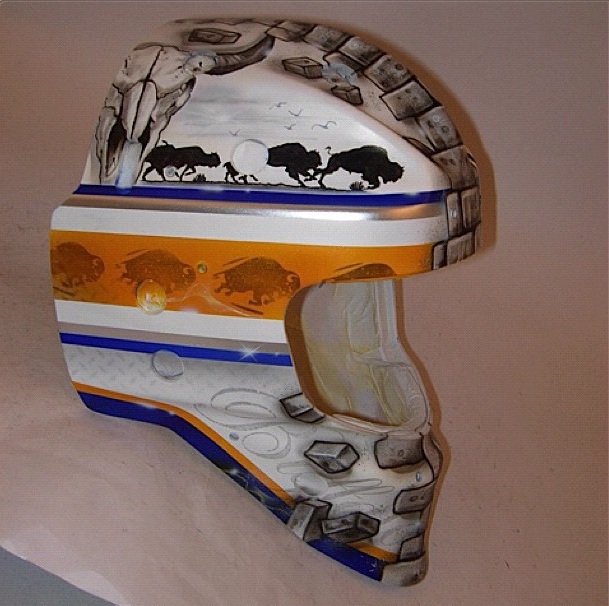
The brick wall art remains down the middle of the design with the Sabres primary logo prominent on the left side. On the right side is a combination of the jersey stripe form the white uniform, silhouettes of bison, Buffalo scripted on the chin and a badass longhorn skull.
Aside from providing the most vivid, sharp artwork on a mask, Gunnarsson’s specialty is working stripe patterns into his masks. This instance makes the blue, silver and gold stripes a focal point of the right side despite being the most basic portion of the artwork.
The buffalo from the primary logo adorns the gold stripe while silhouetted bison run above the upper blue stripe. Gunnarsson also worked a diamond plate pattern near the chin. However, the longhorn skull does it for me. Despite being relatively obscured towards the top of the helmet, it reminds me of a mask once worn by Grant Fuhr during his time here. That mask that Fuhr wore was my favorite Sabres mask of all time.
Combining this mask with the white bison helmet that Ryan Miller will wear ought to give the Sabres the best one-two punch of helmet artwork in the league.
Conjecture department: Could a lockout benefit the Sabres?
Might this lockout be a good thing? Not for the game or fans, mind you; but for the season.
When I look at the Sabres past few seasons, there has been a significant lull in performance at some point. Whether that came at the beginning of the year (2010-11) or in the middle of the year (2011-12), the team has suffered from a drop off that ultimately cost the team wins and position in the standings.
Obviously last year’s mid-winter slump was centered around injuries and horrible play, but fatigue and the grind of the season likely had something to do with it. Since it seems as if a lockout is inevitable at this point, could it be somewhat beneficial for the Sabres to play a shortened schedule?
Perhaps a shortened season would allow for Buffalo’s offensive players to stay fresh over the entire course of the season. The same would go for the goaltending and defense. In fact, shortening the schedule could be massively beneficial for Ryan Miller, whose workload would potentially go from 60+ games to 40+ games. That is, of course, if Lindy Ruff utilizes Jhonas Enroth properly.
There are a few permutations here that serve as counterpoints to this train of thought. First, a shorter schedule would also cause the league to condense games into a smaller package in hopes of keeping the 2012-13 season to an adequate length. This will cause more back-to-back matchups and could potentially create more wear and tear on the players.
Secondly, every team will be playing a shorter schedule. Because of that, every team will reap the same benefits from trimming the schedule down from 82 games. It’s not as if the Sabres are tailor-made to sprint as opposed to finishing a marathon or gaining any sort of added advantage compared to the rest of the league. Continue reading

