Sabres have an arsenal of first and second round assets

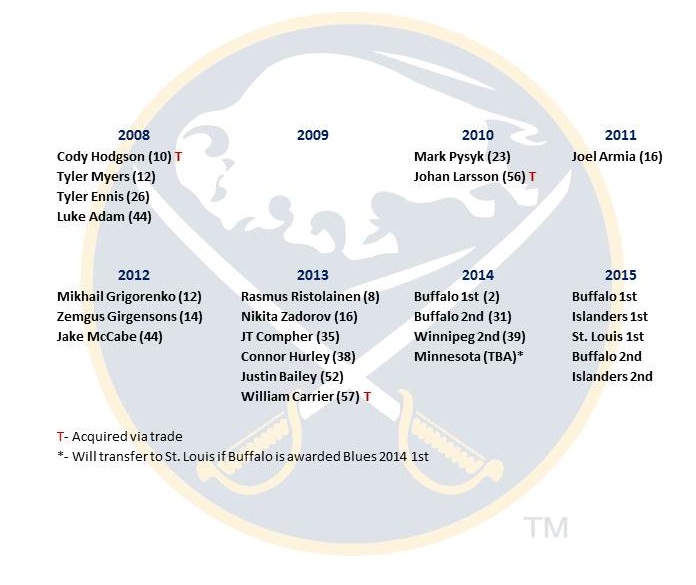
If you read Paul Hamilton’s post on WGR 550 today you may have noticed the bevvy of players he referenced. A great many of those were selected in the first two rounds of the draft (as he mentions). After reading his post I wanted to find a way to illustrate exactly what the Sabres hold from the actions they’ve taken over the last few years.

The Sabres hold nine picks in the first and second round of the next two drafts. After the trade deadline the Sabres had sixplayers selected in the first two rounds of last year’s draft. Should the Sabres hold onto all of their picks and not make any trades involving players selected since 2008, the Sabres will close the 2015 draft with 25 players in the system who were selected in the first two rounds of the draft between 2008 and 2015.

That’s a long look at the organization as anyone selected since 2008 are beyond prospect status at this point and there’s no way to tell what Tim Murray’s strategy will be with the pick he possesses between this year and next. It’s a safe bet to say that he won’t sacrifice any of the three firsts he holds next year with his only course of action regarding the 2015 first round being to obtain more selections.

A pair of picks that I’m very interested in are the two at the top of this year’s second round. Buffalo holds the first pick of the second round (31) and Winnipeg’s selection (39)thanks to the deadline day trade of Matt Moulson. They’re high second round picks in what is considered a weak draft, so they may not carry all that much weight. I also think that targeting Thatcher Demko with the 31st pick could be a direction the Sabres go. I’d also be interested to see if either, or both, of those picks could be used to sweeten the pot on a draft day hockey trade if Murray is able to find a dance partner.

What I think is important to keep in mind about this – Hamilton touches on this when he refers to how envious other organizations are of the Sabres – is that the doom and gloom surrounding the state of the organization is somewhat misplaced. The Sabres have a ton of assets and while those selected prior to 2010 may by closer to veteran than prospect status, the organization’s roots run deep. This is not a team that has been spread thin by buying rentals and temporarily patching weak spots. While the holes in the current roster run rampant, the framework to fix them are in hand and will start to be acquired as soon as June 28.

As I said, I wanted to illustrate the arsenal of high picks and assets Hamilton mentioned in his post. The fun starts at the draft in Philly and will continue through to next season. If used properly, the assets listed below could significantly speed up the rebuild. 1st two round
Where are the Sabres picks?

Tim Murray was awfully busy in the past week starting on Friday when he moved Ryan Miller and Steve Ott to St. Louis. That started the ball rolling for Murray’s first trade deadline as a general manager and when the dust settled the Sabres had made four moves involving 15 players and prospects and seven draft picks.

Things may have gotten particularly cloudy with the draft picks as the Sabres not only shipped out three on Wednesday, but have also acquired quite a few over the next few seasons in trades dating back to last year’s swap with Minnesota. A number of these picks are also controlled by various trade conditions that could drastically change the landscape of what the Sabres own in the 2014 draft and beyond.

For example, should the Islanders choose to keep their first round selection in this year’s draft – a condition that stipulates the pick must be in the top-10 – the pick will transfer to the 2015 draft. Should that occur the Sabres will own three first round selections (barring any trades) in what is expected to be a deep first round.

The Sabres could also score an extra pick in this year’s first round if the Blues reach the conference finals or choose to re-sign Ryan Miller prior to the draft. Given that the Blues were knocked out in the second round last year, it doesn’t seem like a stretch to think that is a possibility. However, if the Sabres are to receive that pick, the Blues will get Buffalo’s third round selection in 2014 along with the second round pick Buffalo obtained in the Jason Pominville trade last year. If the Blues miss the conference finals and happen to re-sign Miller after the draft, Buffalo winds up with St. Louis’ 2016 second round pick.

Confused yet? In order to provide some clarity on the situation, here’s a graphic on what picks the Sabres own and what picks have been moved.

Feel free to point out any errors.

Tough choices for Snow will benefit Sabres

A funny thing has happened in the past month-and-a-half. Since sacrificing three major pieces to obtain Thomas Vanek from the Sabres, the Islanders have been in a veritable tail spin; a tail spin that has taken them to just a handful of points away from the Sabres home in the NHL’s basement.

Sam Reinhart remains the target this year, but the Sabres arsenal could be stacked depending on the decisions Garth Snow makes in the coming months.

New York’s descent to the bottom of the Metro Division and NHL standings have left the organization, Garth Snow specifically, in a precarious situation as the rest of this season unfolds. Despite the massive shortcomings in the Metro Division, it would appear that the Islanders are dead in the water with regard to the Eastern Conference playoff picture. That leaves them just a few points from the basement and the potential to land a top-five pick based on their spot in the lottery. But with the Islanders due to fork over a first round pick to Buffalo in exchange for Vanek, Snow and his staff will need to determine if they want to lose a potential first round pick this year or miss out on what could be a very valuable chip in the Connor McDavid sweepstakes.

When the Vanek trade went through, determining which pick would turn Snow from saving to sacrificing his 2015 pick was a hot topic of conversation. However, talking about what Snow’s train of thought would be with a pick in the five-to-eight range is much different than if the Islanders are picking in the top three. The former being the more popular train of thought as a late slide out of playoff contention seemed like it could be the most likely scenario the Sabres would find themselves in terms of snagging a second first round pick this year.

With the Islanders struggling as badly as they have, a few more factors come into play with regard to their next two first round picks. Continue reading

The Instigator 2.8 – Cool Draft

Eric and I got together once again for an Instigator Podcast. In this episode we discuss the Sabres decisions at the draft table, the Andrej Sekera trade and whether or not Ryan Miller or Thomas Vanek will be on the team next season. As always, we close things with plus/minus.

Have a listen and feel free to share feedback:

Drafting the Sabres: All-Time greatest picks

With the draft just two weeks away, I’ve been taking a look at some different points in Buffalo Sabres draft history. As the Sabres enter a draft with two valuable first round selections and two more second round choices, I thought I’d take a look at the best players selected in each round throughout franchise history.

Much like the All-Time first round picks post I ran earlier this week, this is to serve as a comprehensive breakdown of the best player the Sabres have found in each round of the draft dating back to their first selections in 1970. While the draft extended upwards of 12 rounds years ago, I only took this to round 10 as the pickings were slim enough past the seventh round. In addition to the primary choice for each round I will add in other, random, picks from throughout Sabres history. Some will be great picks while others will be fun to remember where they were chosen.

Starting with the first round, here is the All-Time Sabres draft breakdown: Continue reading

Regier manuvers for the future with deadline deals

Darcy Regier wouldn’t say it outright in his press conference, but he maneuvered the trade deadline like a general manager leading a rebuild.

Regier’s moves netted the Sabres eleven total picks over the first two rounds of the next three drafts. Eleven picks. That includes two first round and two second round picks this year, a first and three seconds next year and a first and two seconds in 2015. In addition, Regier acquired a pair of prospects in his haul from the Jason Pominville trade.

Jordan Leopold and Robyn Regehr probably weren’t going to be part of the team’s plans for 2013-14 as the season began to spiral out of control. Regier got the maximum return that he could for each player and pulled the trigger. Given that second round picks are valuable commodities, he did a good job in netting a trio of the picks for his two pending free agents.

While the Pominville trade was somewhat expected, the magnitude of the deal may not have been. Two picks (first in 2013, second in 2014) and two NHL-ready prospects for the former captain is a solid haul and specifically the type of trade that is relatively foreign when you look at the moves typically made by Regier.

While the Sabres haven’t been in full sell mode for some time, Regier has also never had to deal with shipping out such a valuable commodity. The closest you could come would be getting Steve Bernier and a first for Brian Campbell, but even that pales in comparison.

Regier had to go into sell mode, there is no denying the position that he was in. There is a good chance that a majority of Sabres fans want Regier gone and they aren’t off base in that desire. He probably isn’t the man to complete the process of the rebuild but that doesn’t mean he didn’t take the right step forward with the moves he made.  Of course, there is no guarantee that he will survive long enough to take the next step in this process. Continue reading

Sabres stay focused on centers on day two of draft

With Friday’s fireworks in the rearview, Darcy Regier and his scouting staff went to work with six picks in rounds two through seven of the 2012 NHL Draft.

While they shipped off their very first pick of day two in order to draft Zemgus Girgensons, Buffalo was able to net an impressive amount of size and talent with their remaining picks. With their nine picks, the Sabres took five centers with their eight picks at the draft, picking up a pair defensemen and one goaltender.

There is no longer a need for organizational depth at center after the past two days. Counting Luke Adam, Tyler Ennis and Cody Hodgson, the Sabres have 12 centers in their system. With Girgensons and Mikhail Grigorenko flirting with an immediate jump to the professional game, these improvements will be felt at every level.

The Sabres also were able to begin re-stocking their crease after signing the only two  goalies they had in the pipeline. After a commitment to defense in the mid-2000s, the blueline still has some prospects on the way that will be enhanced by this draft.

Buffalo’s commitment to centers and adding more big, skilled players was the obvious trend in this draft and I would expect that to continue for at least one more year. For a full rundown of the Sabres draft, I will defer to Sabres Prospects. But here are a few thoughts I have on each of Buffalo’s day two picks:

Jake McCabe (2nd round, 44)

McCabe is fairly well sized and just finished up his rookie year at Wisconsin with adequate numbers. I think the most promising part of this selection is that Wisconsin has become Defenseman-U in the past  few seasons churning out talent like Ryan McDonaugh and Jake Gardiner.

Without much prior knowledge of McCabe I am happy with the choice. He played for Ron Rolston in the US Development Program and Kris Baker notes his solid two-way game as a reason to look to the future. I’d venture a guess he plays at least two seasons in the NCAA before signing a pro contract. Continue reading

Regier gets bold with a pair of centers

Sabres fans can finally take solace in the fact that the team has a pair of big, talented centers in the system. Buffalo chose Mikhail Grigorenko with the 12th overall pick and then trade up to select Zemgus Girgensons at number 14.

Mikhail Grigorenko and Zemgus Girgensons

Grigorenko’s stock had slid in recent weeks with allegations that he was basically a typical, lazy Russian and those allegations allowed the Sabres to snag him at 12. However, Grigorenko was still the third-ranked North American skater entering the draft. His 85 point season (40+45) for Quebec in the QMJHL shows as much. Based on the way the opening picks played out, Buffalo was fortunate to pretty much have their pick of the littler based on who was available at 12. Their obvious need for a center and Grigorenko’s availability made for an easy choice of the best player available.

The selection of Girgensons wrapped up a 365-day cycle between the Sabres and Flames that began at the 2011 Draft when Buffalo acquired Robyn Regehr. To get up to 14, Regier hit up Jay Feaster, who is quickly becoming the target for Regier’s most maniacal trade propositions. Buffalo was able to leap seven spots to select Girgensons with the 14th pick.

The price to move up was Buffalo’s second first-round pick (21 from Nashville) and their own second-round pick (42) in this year’s draft. The Sabres still have pick 44, acquired from Calgary last season. Calgary chose to take Mark Jankowski, a forward from a Quebec high school prep league, slated to play for NCAA powerhouse doormat, Providence next season. Jankowski probably projects to a four or five-year project and has many question marks surrounding the competition he played against prior to the draft.

To recap, Regier traded Paul Byron, Chris Butler and the pick that became Jankowski for Robyn Regehr and the pick that became Girgensons. The second round pick exchanged is basically a wash since the Sabres retain the pick they received from the Flames in 2011. Suffice it to say I am okay with the way that shook out. Continue reading

Sabres can benefit from stockpiling picks

The recent debate over the course of action the Sabres should take in the first round of this year’s draft has added to the trend of blue chip prospects entering the NHL as 18-year olds. It also would appear that development of NHL prospects is slowly changing the yearly event from a futures draft to an event that produces players that are prepared to enter the league almost immediately.

With the salary cap pressing out those players with mid-level salaries, young, ultra-talented prospects have begun to be fast tracked into the NHL. The Philadelphia Flyers’ use of Claude Giroux, James van Riemsdyk and Sean Couturier makes for a great example of this. Even the Sabres have seen Luke Adam, Tyler Ennis and Tyler Myers make a quick jump to the show.

Keeping all four picks could result in Buffalo landing physical center, Stefan Matteau.

Because of the trend away from a two or three-year development to a track closer to 18 months (or shorter), picks in the top five have become that much more valuable as compared to years past. In fact, dating back to the Crosby draft, Erik Johnson is the only first overall pick not to enter the league as an 18-year old. With Nail Yakupov, Alex Galchenyuk and Ryan Murray all lurking atop this year’s draft, there is room for more NHL ready talent to be selected.

Yakupov and Murray are almost shoo-ins to step into the NHL next season. Meanwhile, Galchenyuk, Matt Dumba and Mikhail Grigorenko are also good bets to make a run after their first NHL training camp.

While Darcy Regier all but shut the book on any possibility of trading up in the draft, I remain a proponent of making a run for one of the picks that would yield the young center. I see Glachenyuk as the number one center the Sabres so desperately need and likely won’t find on the open trade market. However, Regier seems to be content with keeping his four picks and stocking the cupboards. Based on the trend of the NHL draft, the case could be made for trading up or standing pat. Continue reading