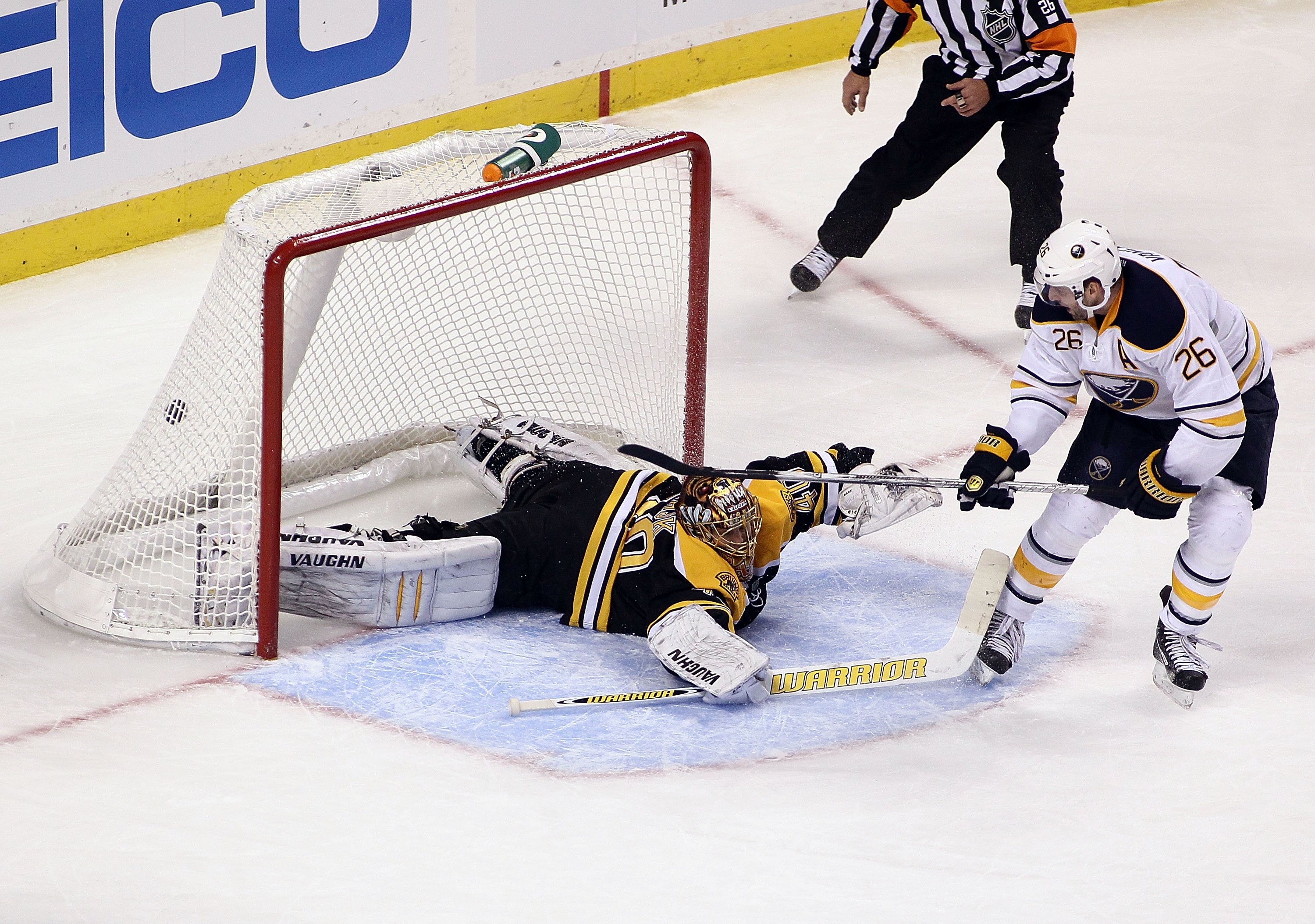
Grading the Sabres: 2013 report card, Part II

The defensemen and goaltenders get to share the spotlight in the second portion of my Sabres season grades. As always, your thoughts are welcome in the comments section.

Tyler Myers: Oh, where to begin? Myers was downright bad to begin the year before leveling out at midseason. He looked out of shape and lost most of the time and his play suffered for it. Considering the salary he is being paid, his contributions are especially frightening. Before his injury he was only okay and you could certainly say the defensive play was better without him. Yikes. Grade: C-

Christian Ehrhoff: Ehrhoff finished off another strong year in which he remained Buffalo’s best defenseman. He hasn’t blown up the scoresheet like some expected, but his powerplay time has changed from the Sedins to any number of players in blue and gold. Still, there’s a lot to like about Ehrhoff and he will be around for a long time. Grade: A-

Andrej Sekera: Everyone’s favorite whipping boy, Sekera actually wasn’t bad at all this season. He quietly goes about his business and plays steady hockey. I’m not a huge fan of his but I can’t deny that he has been a solid contributor in his own end all year. Grade: B

Mike Weber: Steve Ott’s arrival may just be the best thing for Weber’s career you could ask for. Weber is beginning to evolve into a leader, plays a gritty nasty game that is almost entirely absent on this roster. His puck skills aren’t very good, but as a defender there is a lot to like. He may still be on the rise for this squad. Grade: B- Continue reading →

Grading the Sabres: 2013 report card

A fired coach, traded captain, booing fans and missing the playoffs typically doesn’t not make for a very successful season. That was certainly the case for the 2013 Buffalo Sabres.

While there were a few bright spots amongst the doom and gloom, the lockout shortened season is certainly one to forget for the Sabres. Before shutting the door completely I wanted to grade out the team and players on how the year played out.

Team

Coaching: It had been rumored that Lindy Ruff’s message had grown stale some time ago. Finally, after a number of listless losses, Ruff was fired after nearly two decades coaching the Sabres. Frankly, it just looked like the team had tuned him out and needed a change. While Ron Rolston arrived and helped to energize the roster, his presence wasn’t enough to lift the Sabres back into playoff contention. Entering the offseason, many are wondering if Rolston will have the “interim” tag removed from his title and command the bench for a full season. Grade: C

Powerplay: It is almost as if the Sabres don’t consider the possibility of an odd-man rush against while on the power play. It also seems likely that trying the same thing over and over again (zone entry) is not the definition of insanity. The power play simply wasn’t good this season and endured a massive dry spell in the thick of Buffalo’s ugliest stretch of losing. They would get an F but they managed to score every now and then. Grade: D+

Penalty Kill: Buffalo decided to run a unique, if not peculiar penalty kill which basically turns into a 1-1-2 in the zone and rotates with the puck. After Ruff’s departure it appeared as if things began to change, but the base of the kill still worked off the 1-1-2 set up seen earlier in the year. I personally didn’t like it as the second forward was rarely in the right position to deny passes across the zone. Grade: C-

Management: A lot was made over the end of the season press conference and other silliness. My focus is on what Darcy Regier did for the hockey team and if he made them better or worse. He traded away two veteran defensemen and his captain and came away with a first round pick, five second round picks, Johan Larsson and Matt Hackett. Overall it was a solid haul for what was given up (Leopold and Regehr) but the pieces acquired really won’t have much impact for at least two more seasons. Add in the firing of Ruff and it was a pretty tough four months for Regier. While he handled himself well I find it hard to see how he still has the reigns for this rebuild. Grade: C Continue reading →

Instigator Podcast 2.7 – Petulance Defined

Eric and I got together for another Podcast last night in the wake of yesterday’s press conference. We touched on a few points outside of what went on at the press conference. Specifically what Darcy Regier may be doing this summer, the future of Ryan Miller and Thomas Vanek and we also made sure to support our self-serving narrative which we pre-prepared.

Buffalo Sabres 2013 2ITB Awards

The 2ITB Awards made their debut last season after the Sabres’ playoff push fell short. After a disappointing season, here are my picks for some serious and not-so-serious team awards:

Most Valuable Player – Thomas Vanek

Atlas Vanek put the team on his back for most of the season. He and Ryan Miller performed at a high level for most of the year – although Miller’s numbers reflect that of a more average goaltender. Vanek’s contributions are more visible and he is certainly deserving of recognition on a team that would be dreadful offensively without his skillset. Here’s hoping he isn’t traded.

Least Valuable Player – Drew Stafford

Just a dismal year for #21. Stafford could never get the train on the tracks and has been largely invisible on many nights. He wears a letter to boot. To think that he makes $4 million a year is a cap crushing nightmare. I would assume he gets traded in the offseason, but that is no guarantee.

Top Prospect – Mark Pysyk

Looking at the body of work each Sabres prospect put together this season, Pysyk is probably the one to stand out the most. Just as 2011-12 winner Marcus Foligno put together a strong stretch run, Pysyk has set himself up very well for his first full NHL season for 2013-14. Continue reading →

Trading Ryan Miller: Who will be looking to buy?

This will serve as the second portion to a post that I put up last week on the prospects of trading Ryan Miller

After exploring which teams may or may not make Ryan Miller’s no-trade list, I wanted to take things a step further and determine which teams may serve as suitors for the netminder. By doing so I wanted to determine which teams would have little interest in him as well.

As is well-known, Miller’s no-trade clause allows him to veto a trade to eight different teams. This may end up being a list that significantly handcuffs Darcy Regier but it could also serve as a list that does indeed limit options, but doesn’t prevent Regeir from effectively doing his job.

I decided to include the 11 different teams which Miller may veto a trade to on this list. I wanted to provide a comprehensive collection of the direction I’d assume each NHL club to take if approached about Ryan Miller.

Count the Rangers (Lundqvist) and Penguins (MAF) in a group of teams who would not provide themselves with a significant upgrade in acquiring Miller. Boston (Rask), Nashville (Rinne), Los Angeles (Quick), Vancouver (Schneider), Montreal (Price) and Detroit (Howard) are also on this list. Each of those seven teams have determined their goaltender of the future (and present) and wouldn’t provide their team with any sort of significant upgrade by bringing Miller into the fold.

There is another large group of teams who have a solid netminder and fall in the middle of the road when I consider potential suitors. They probably all lean closer to a no than a yes and here’s why: Continue reading →

Trading Miller: What teams make Ryan Miller’s no-trade list?

Trade talk surrounding Ryan Miller has never been hotter as the Sabres begin to enter a rebuild and the potential to gain a handsome return for the former Vezina Winner. Acquiring valuable assets for the goaltender has become a hot topic as many question if he will return after his contract expires next summer.

What stands in the way of dealing Miller is his limited no-trade clause. Miller is able to provide a list of eight teams that he will veto a trade to, thus limiting Darcy Regier’s options. In addition, the impressive glut of quality goaltenders around the league could further limit trade partners for the Sabres.

I assume that Regier would try to avoid a similar situation to what played out with Jarome Iginla – steering the Flames towards a trade with Pittsburgh due to his no-trade clause – and simply obtain Miller’s list of eight prior to pulling the trigger on a deal. Providing the player latitude on where he wants to go will ultimately reduce the available return in a trade, Regier wouldn’t let that happen.

However, which teams might appear on that list may be difficult to determine.I figure there are three basic groupings of teams that you can pick teams from when considering the list of teams Miller wouldn’t accept a trade to. Keeping in mind that he is in more of a “win now” mode with an expiring contract, his specific interests may be geared towards perennial contenders and avoiding teams that are in the process of building.

I categorized teams as locks (teams which he will almost certainly veto) or bubble teams (teams that likely have a red flag or two). Any other team falls onto a list where he’d welcome a trade. Here’s a closer look: Continue reading →

Sabres trades net quality return, though full value is still pending

While most of the return that Darcy Regier received at this year’s deadlines came in the form of draft picks, there were still a trio of trades made that will affect the Sabres moving forward.

The lone disappointment of the deadline might just be that more moves didn’t go down. Simply expecting a complete overhaul of the roster is rather unrealistic, but with players like Drew Stafford, Thomas Vanek and Ryan Miller rumored to be on the block many expected today to end with more than just one player (not counting Regehr and Leopold) sent on to a new team.

Grading the moves isn’t appropriate in many ways because these are moves that have set up for the future. Unlike recent deadlines in which players were brought in to bolster the lineup, 2013 was a year in which the opposite was true. There was no Cody Hodgson acquisition to base an opinion off of, which does make things slightly difficult when considering that a majority of what was acquired may not pay off until this summer at the earliest. Continue reading →

Regier manuvers for the future with deadline deals

Darcy Regier wouldn’t say it outright in his press conference, but he maneuvered the trade deadline like a general manager leading a rebuild.

Regier’s moves netted the Sabres eleven total picks over the first two rounds of the next three drafts. Eleven picks. That includes two first round and two second round picks this year, a first and three seconds next year and a first and two seconds in 2015. In addition, Regier acquired a pair of prospects in his haul from the Jason Pominville trade.

Jordan Leopold and Robyn Regehr probably weren’t going to be part of the team’s plans for 2013-14 as the season began to spiral out of control. Regier got the maximum return that he could for each player and pulled the trigger. Given that second round picks are valuable commodities, he did a good job in netting a trio of the picks for his two pending free agents.

While the Pominville trade was somewhat expected, the magnitude of the deal may not have been. Two picks (first in 2013, second in 2014) and two NHL-ready prospects for the former captain is a solid haul and specifically the type of trade that is relatively foreign when you look at the moves typically made by Regier.

While the Sabres haven’t been in full sell mode for some time, Regier has also never had to deal with shipping out such a valuable commodity. The closest you could come would be getting Steve Bernier and a first for Brian Campbell, but even that pales in comparison.

Regier had to go into sell mode, there is no denying the position that he was in. There is a good chance that a majority of Sabres fans want Regier gone and they aren’t off base in that desire. He probably isn’t the man to complete the process of the rebuild but that doesn’t mean he didn’t take the right step forward with the moves he made.  Of course, there is no guarantee that he will survive long enough to take the next step in this process. Continue reading →

Waiting on a surprise from Regier at the deadline

If history is to serve as a guide you can assume that Darcy Regier will make at least one fairly significant move at this year’s deadline. Perhaps a move will come in the days leading to the deadline, but Regier has made at least one move around the deadline in each of his years with the Sabres.

This year is different than most in recent memory due to the struggles on the ice and the calls for change from the fans and media. A great many are rightfully worried that Regier is not the man who should be guiding any sort of rebuilding process as he is the very architect who assembled the flawed roster that has hovered near the bottom of the league this season.

Buffalo will play a trio of games prior to the deadline and a string of losses would all but cement Regier as a seller. Granted many reports have indicated that the Sabres are willing to hear offers on the entire roster, three more losses would leave little doubt that the team will miss the playoffs yet again.

Whether or not you think Regier is the right choice to even begin retooling the Sabres roster is immaterial at this point. Fans have been calling for his head even before Lindy Ruff was fired but it is obvious that management isn’t willing to cut the cord on Regier at this point and the axe certainly won’t fall prior to Wednesday’s deadline.

Regier will indeed be the guy making and taking the calls for the Sabres on deadline day. However, he’s typically been an adept trade negotiator and has shown that his measured patience often yields the best results (see Gaustad, Paul).

I previously opined that the Sabres don’t need to enter this deadline as just sellers and I stand by that argument. This isn’t a team in the middle of a rebuild in which additional picks and prospects are the ideal return. The Sabres are a team with a flawed construction that could use a facelift. That means that hockey trades and some recycling would likely be in the best interest for the roster.

Moves like last year’s Cody Hodgson trade will allow for the Sabres to introduce pieces that can not only help in the future, but impact the roster today. Continue reading →

New division, same challenge face Sabres under realignment

Funny how 12 months, an intense labor debate and relatively happy returns from fans can change how things work in the NHL.

When realignment was brought up last season, the NHLPA shot down the proposal citing a number of issues surrounding travel and questions about the playoff format. After burning a major portion of the season to a lockout, the NHL and PA put through a realignment plan for next year that was nearly identical to the one that was vetoed last season.

There are some significant changes to this plan compared to the last proposal. Both Detroit and Columbus come East, leaving the league with unbalanced conferences; a wild card option has been instituted to keep a competitive balance for the playoffs; lastly, the recently approved plan ensures every team will appear in every arena over the course of the year.

The Sabres will welcome three new division rivals to their yet-to-be-named division dubbed as “Division C” in the most recent league graphic illustrating the new conferences. In addition to their current Northeast Division rivals, the Sabres will welcome Florida, Tampa Bay and Detroit to their new division.

The Bolts and Panthers ended up being the black sheep of the entire realignment as they’re geographically hamstrung compared to the rest of the Eastern Conference. Short of splitting them between the two divisions (an unrealistic option), the NHL had limited options with their two Sunshine State franchises. Detroit (along with Columbus) made good on the reported promise made by the league to get them into the Eastern Conference, away from 10:00 starts and into a division with relatively limited travel.

Buffalo will play five games a year against division opponents, three games a year against the other Eastern Conference teams and 28 total against the West.

While the new division alignment doesn’t stack the odds against the Sabres, it doesn’t necessarily favor them either. Finding success within their division may not be as much of a challenge for the Sabres as remaining above those teams from the other Eastern division.

Continue reading →