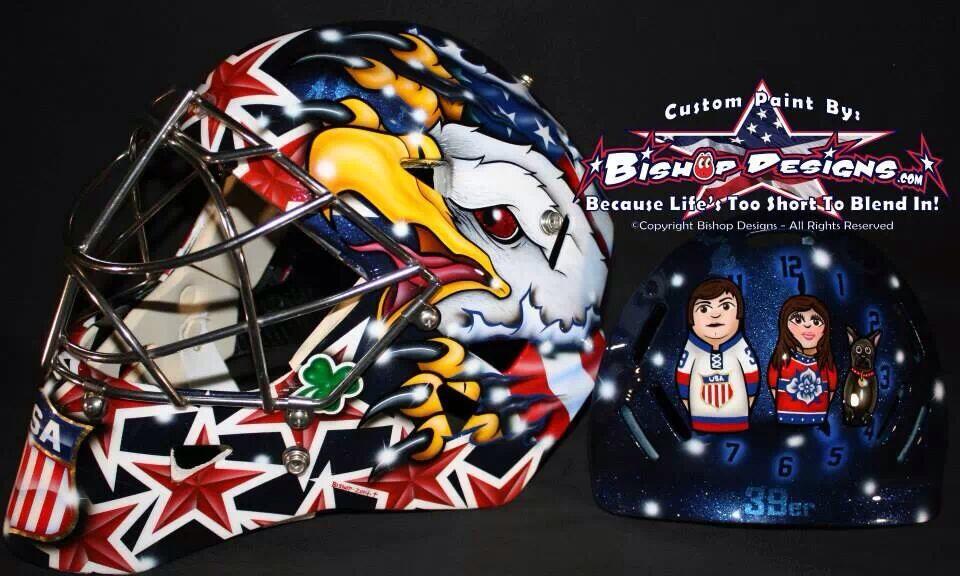
Time for EA to add real mask art to the NHL series

The first trailer for NHL 15 was released yesterday and a lot of the new graphics make the players look as if they were modeled after wax figurines.

Among the numerous changes to the franchise, more realistic arena details will be included thanks to the technology in the next-gen consoles. But I’m not here to give a review of the game, the new features or anything like that. I’m here to point out how EA Sports has continued to miss the boat with some of the smaller, but more noticeable details in the only worthwhile hockey franchise available to gamers.

The developers at EA continue to add more and more authentic gear to the NHL series and that is a welcome addition that I look forward to every year. It not only adds authenticity to the game itself, but for gear nerds like myself, it’s a cool addition to play with whether you’re creating a player or making trades in Be a GM mode. However, for as detailed as they’ve been in adding gloves, skates, sticks and goalie equipment, they’ve been just as lazy in ignoring the most important piece of gear in the game: goal masks.

The standard should be higher than this.

Each team has two very, very generic masks that each goalie can use that fall somewhere between the old Franklin SH Comp team masks and an MS Paint creation of jersey stripes and team logos. This all from the leading company in sports video games. There seems to be little or no effort being put forth to bring more mask options to the game, nor does there appear to be any effort being put forth to bring actual masks to the game. As an aside, Rick DiPietro had his actual mask featured in a previous version and EA also added Martin Brodeur’s timeless design in NHL 13. But that’s where it ends. Two real masks and a collection of poorly designed masks for the rest of the game.

Perhaps EA was devoted to capturing all the intricacies of each team’s arena for NHL 15 which caused them to overlook their goaltenders. That is a respectable excuse in that more people will notice and complain about generic, cookie cutter arenas than they will about generic, cookie cutter goal masks. Hell, EA not only has the orientation of First Niagara Center wrong but they’ve been using an incorrect jersey numbers and lettering for the Sabres for some time now. Not to mention the Sabres have two different colorways for home and away gloves – I’m a gear nerd, like I said.

The solution here isn’t much different than the solution EA came up with for the arenas. They simply need to devote the time to adjusting the designs for each team to better reflect actual masks. They could also get the rights from each painter for their masks and actually build out each goaltender’s authentic design. The latter would take more effort, but it would also make the game much cooler. Continue reading →

Building a winner takes more than just top picks

As the final two weeks tick away until the Sabres make the first pick in the Tim Murray era, Tyler and I decided to team up to offer an all-encompassing analysis of how the most recent Cup winning teams were constructed. We started with the 2008-09 Pittsburgh Penguins and went straight through this year’s Kings and Rangers rosters.

We found a number of different trends and traits on each of these teams. One trait they all shared was the possession of at least one high pick (fifth or higher) who was either drafted by the team or became a priority acquisition at one point or another. However, just as important as these players were to their respective teams, proper acquisitions via trades or free agency served as an equally important trait for each and every one of these teams.

Anze Kopitar: picked 11th overall in 2005.

Our goal was to offer a comprehensive analysis of each of these teams to illustrate exactly where the Sabres still need to improve their roster outside of simply winning the Draft Lottery.


Chris: The current state of the Sabres has inspired a lot of debate regarding rebuilding and the best course of action to take. One particularly incendiary stance taken by Jeremy White is that it doesn’t matter who your GM is so long as you’re picking at the top of the draft. While I’m sure his point was that anyone can pick first since you’re likely to land a surefire stud with a top-three selection, the comment has turned into a rallying cry both for White and his critics.

I know we both disagree with his premise given that hockey teams are comprised of 23 players, not one or two. Without giving away the entire argument in two paragraphs, I feel it’s important for anyone to understand that shaping a championship team takes a hell of a lot more than simply picking first a few times. It’s a perfect storm of drafting, trades, free agent signings and cap management. Comparing the state of the Sabres to other teams who have enjoyed a turnaround after picking high – Colorado comes to mind as a great example – it’s safe to say that Aaron Ekblad or one of the Sams aren’t going to turn things around by themselves, no?

Tyler: Whoever Tim Murray opts to take at 2nd overall at the end of the month will not come in, put the team on his back, and carry them to a top three finish (and automatic playoff spot) in the Atlantic Division. I’d venture to say that even if Murray were to acquire another top five pick in June (as Mike Harrington believes they should) they still would find themselves outside of the playoff picture. That is not an indictment of the skill of any of the top prospects, but of the current roster. The Sabres have a multitude of holes to fill, and while one or two of Bennett, Reinhart, or Ekblad would no doubt but the team on the right track there’s still a long way to go. Continue reading →

Looking back at the Draft: 2006

This is part three of a five-part series looking back at previous NHL Drafts between 2004 and 2009.

I noticed that the juiciest years to analyze fell between 2006 and 2009. There weren’t as many players to flame out and head overseas and there was also a healthy contingent on mid and late-round picks that made filling in the top portion of the round a breeze. While none of the drafts held the same type of value of 2005, these relatively recent years offered a bit more to work with.

Like with the last two, the bottom portion of the round does get thin and attributing proper value to some of the players became a bit of a challenge. Continue reading →

Looking back at the Draft: 2005

This is part two of my series of re-drafting the first round of the NHL Draft between 2004 and 2009.

One thing I noticed as I was working on this project was how quickly the bottom of the round thins out. I never had much trouble lining up candidates who had been selected in the second round and beyond, but filling the holes left by the first round misses led the bottom of each first round to be tricky to round out. Luckily there were a healthy number of mid-round picks to choose from in 2005 as the draft itself was very deep.

This draft, particularly at the bottom, became more of a need-based selection process as opposed to simply listing the best players. However, having a happy medium of re-ranking and actually selecting players for need was my goal going into this.

Continue reading →

Looking back at the Draft: 2004

This will be the first in a series of posts that revisits the first round of the NHL Draft. I did something similar with previous Sabres drafts for Buffalo Wins last year and NHL Network Radio on SiriusXM has been doing something along these lines the last few weeks.

I wanted to look back on the first round of recent drafts and to figure out which players worked out, who turned out to be a sleeper and who wound up as a bust. So I took each draft between 2004 and 2009 and re-selected the first round based on the players from the entire draft.

I evaluated and drafted by following a handful of guidelines. The overall goal was to identify where some prospects would be picked if the draft could be reconducted today. I attempted to strike a balance of simply reordering the top 30 players from each draft and making some selections based on who would best aid certain teams.

I didn’t consider each and every team’s draft strategy since I can’t speak to the draft strategy of each team in any particular draft. However, if there was a player that would address a very specific need, goaltenders being the best example, that was taken into consideration. I also looked at each draft independent of those in the preceding or following years. A player’s original draft selection didn’t factor into their new position in this practice.

The first draft I chose to reevaluate was 2004. This draft was headlined by Alex Ovechkin and Evgeni Malkin. As you’ll notice, I will list the team’s new pick first followed by the pick they made originally with a brief explanation for most, if not all of the choices. I will also list where the new pick was originally selected.

Continue reading →

How 2ITB voted in the 2014 PHBA Awards

A few weeks back I was contacted by PumperNicholl from The Royal Half about participating in the first annual Professional Hockey Bloggers Association awards voting. They put together 65 blogs (65!) to vote on the seven big awards.

Each blog was given one entry to select up to five players for each award. Here’s how the voting played out:

Hart Trophy: Sidney Crosby

Norris Trophy: Duncan Keith

Vezina Trophy: Tuukka Rask

Selke Trophy: Patrice Bergeron

Calder Trophy: Nathan MacKinnon

Lady Byng: Ryan O’Reilly

Jack Adams: Patrick Roy

I strongly urge you to head over to The Royal Half and look at the full voting results. The guys at TRH deserve a ton of credit for getting so many blogs together to vote and managing to find 65 bloggers who were able to get all the positions correct.

Here’s how I voted for each of the awards: Continue reading →

Proposing a change to the NHL series format

There’s no question that the NHL Playoffs are the greatest part of every season. An easy argument could be made that the postseason tournament is the best amongst the four major sports. The series format, structure and seeding are nearly perfect with the change back to the divisional format this season.

While there isn’t a thing I’d change about the playoffs in their current form, I’ve wondered recently about an adjustment to the series structure. The idea shuffles the order in which the games are played to not only add value to home ice advantage, but to give the higher seed an extra opportunity to clinch a series on home ice.

The NHL model, as it stands now follows a 2-2-1-1-1 format with the home team hosting games one, two, five and seven. It is far superior to the NBA’s awful, horrible, no good 2-3-2 order that sees the higher seed forced to the road for three straight games. The system that I’m proposing would see the lower seed host the first two games while giving the higher seed four of the final five games. Continue reading →

Decision on 2018 Olympics should be easy for the NHL

It is a 14 hour time difference between the east coast and Pyeongchang, South Korea. That’s five more hours than the nine-hour difference that has fans waking up at all hours of the night to catch Olympic competition at the 2014 Winter Games.

Among other things, the time difference is one reason many think that Pyeongchang will be the first Olympics to not see the NHL send players to participate. However, with the potential for another terrific run by the US driving fans to their television sets, the NHL may need to reconsider their stance on pulling their players from Olympic competition.

The final decision on sending players to the Olympics is complicated. The NHL and NHLPA need to get together with the IOC and IIHF to line up everything from player insurance to the scheduling crunch that comes with a two-week shutdown of the league. But the benefit to the game and the league is massive.

After the US victory over Russia in the prelims, the game led the ABC National News. That’s a non-hockey network leading their national broadcast with NHL stars triumphing for the US. The re-run of overtime and the shootout drew massive numbers and TJ Oshie, Jonathan Quick and others have been all over programs like the Today show as the NHL’s players have taken the forefront for the second-straight Olympics. Continue reading →

Listen as I join the Break the Ice podcast to talk Sabres

I was able to jump on and join Demick of Break the Ice on one of his podcast that covered a whole range of topics that include the glory that is Wegmans, the upcoming Olympic hockey tournament and where the Buffalo Sabres will be headed in their rebuild.

While I had to cut things a bit short, I’m sure I’ll be speaking with him again soon and will likely have him join Eric and I on an upcoming Instigator Podcast once we get back to recording.

Here’s the link to listen to the podcast on Demick’s site and you can download the podcast by following this link.

Give Demick a follow on Twitter at @breaktheicepod


Ranking the masks of Team USA’s goalies

It’s official. All three goaltenders that will be wearing the Red, White and Blue in Sochi have received their masks for the 2014 Olympic Games. Jimmy Howard was the third and final recipient as Ray Bishop delivered his freshly painted mask to him today.

Howard’s mask is a very basic USA design that’s somewhat reminiscent of Ray LeBlanc’s helmet from the 1992 games. While I followed Howard’s mask through the painting process I had high hopes based on the partially painted pictures Bishop Designs was providing on their Facebook page. The sharp, angled lines had the potential to really pop with the rest of the design based on what was being teased.

Ryan Miller’s 2014 Olympic Mask (Bishop Designs)

Ultimately I think it only falls short with the placement of the bald eagle on the top. I’m a proponent of profile views or nothing when it comes to eagles on masks. Blame Ed Belfour if you must, but the straight-on shot of the bird’s head doesn’t really do it much justice. In fact, it gives it sort of a funky chicken look.

Otherwise, the helmet looks awesome. As basic as most of the design may be it plays perfectly. I’m nitpicking when it comes to the eagle on the top because I think the simplicity of this mask ends up winning me over elsewhere. It’s clear that Bishop and Howard were both well aware of the hurdles that need to be cleared when it comes to the IOC’s standards.

I’d have to slot Howard’s mask in as second to Ryan Miller’s on the team this season. Miller’s 2014 mask is nearly identical to that of the one he wore in 2010 but with a few specific changes. He first went with a navy blue base as opposed to the ice blue on his mask from 2010. The change to a navy base triggered a change from blue and red stars to just red stars on the mask. He also went with the Team USA jersey shield on the chin as opposed to any logos associated with Sochi along with a change to the backplate. Continue reading →