At long last, the entire North Aud Block site is under construction, marking a significant milestone in the decades-long pursuit of developing Buffalo’s waterfront.
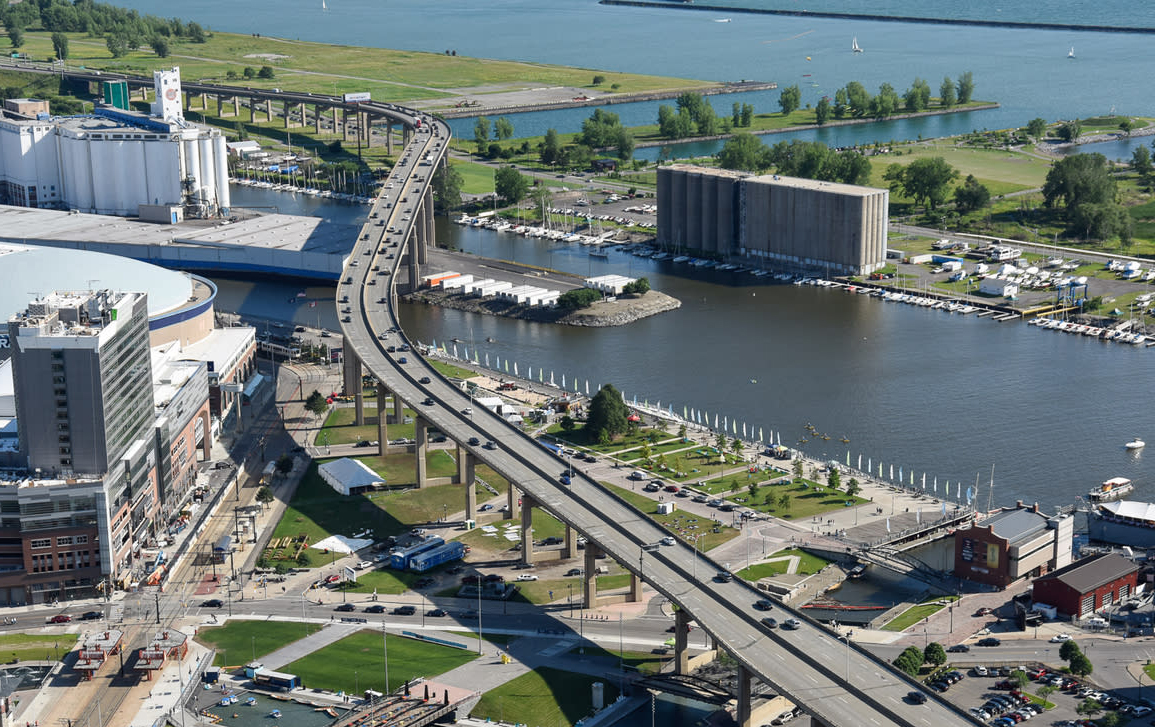
Now that the increasingly controversial Pennrose project is underway, and Heritage Point has picked up pace, the entire footprint of the former Memorial Auditorium site is on track to be filled. That leaves the East Canal Block – sandwiched between One Canalside and Harborcenter – and the Canalside parcels bounded by Main, Scott, Lloyd and Prime Streets left undeveloped. While the Aud Block was the most prominent development site within Canalside due to the gaping hole that once housed the arena, the remaining parcels may hold the most promise.
I think it’s important to consider the development of Canalside as a key influence on a larger arena and entertainment district centered around KeyBank Center and the water. Between Canalside, the arena, the Cobblestone District and the river, there is a year-round confluence of activity that goes well beyond the nights the arena is in use. Despite the years of starts and stops, the area as a whole is oozing with potential as a key entertainment destination for residents and tourists alike. With the two residential projects underway and the Golisano Institute set to occupy The Buffalo News building, there is momentum to build upon in and around Canalside.
It’s vital that the momentum of these projects is seized upon. If the decision is to wait and see what happens once the apartments go up, we’ll be waiting even longer to see the next phase of action. There is ample opportunity to develop the remaining parcels within Canalside. Utility work was completed on the East Canal parcel four years ago, making that a shovel-ready site. Various plans from Benderson over the years called for a mixed use development with a residential component on the upper floors. It was even targeted to be the home of Hofbrauhaus at one point. Meanwhile, the parcels along Main St. directly across from Harborcenter would bring density to the space between Canalside and KeyBank Center.
Bringing additional mixed-use projects to those parcels would do a few things for the area. First and foremost, additional market rate residences would quell the concerns over the North Aud development. The affordable component of that project has drawn harsh criticism that is understandable for what is supposed to be the city’s premier entertainment district. It’s troubling that one of the most visible and important development pads within Canalside needed an affordable component to make the financing work, though I hope that was due to the size and scale of the project. Depending on which side of the criticism you fall, the North Aud project is either 75% affordable or a comfortable 50/50 split. Based on the reported rents being $1,900 and higher for the 80% AMI and market rate units, I think the overall income mix is being overstated by critics. That being said, an onus should be placed on market rate residential for the next projects to create a healthy, diverse income mix for the neighborhood that is growing in the area.
The Main St. parcels seem like an ideal space for the Sabres to latch onto. Pete Guelli has previously mentioned how the arena needs to connect to the neighborhood around it, using phrases like “a catalyst for growth” in media appearances. The Bills have expressed interest in engaging in the development around Highmark Stadium and I can’t help but think they have a similar vision for the arena. There were rumors several years ago that Terry Pegula and the Sabres were going to be named the preferred developer for the parcels in question, and I wonder if a similar agreement could be back on the table. If not solely involving the Sabres, perhaps some sort of partnership between the Sabres and a developer.
The Skyway has often been cited as an impediment to developing the remaining Canalside parcels, but the space along Main St. should have more than enough of a bumper to avoid any impact with the Skyway. Picture a multi-story mixed use structure on that block, with ground floor space reserved for bars or restaurants and residential above it. If the Sabres were indeed the primary developer, they could position the restaurant to sit kitty corner to the arena with a second floor patio that overlooks KeyBank Center and the water. Running the development up to the corner of Main and Scott (across from Heritage Point and Tim Hortons) would create a unified street wall and much needed density in the area. The blend of residential and commercial would also be an excellent complement to the arena as Guelli and the organization continue to push for more events outside of the Sabres and Bandits regular season schedules.
That parcel, along with the East Canal Block would string together a more dense, connected neighborhood that would feature the Golisano School, One Canalside, Harborcenter, the Aud Block properties, the arena and Cobblestone district. The redeveloped DL&W train shed would be another once plans are agreed upon. I, for one, hope the NFTA and Savarino can come to an agreement, as the plans laid out last summer would be a perfect fit for the space and, more importantly, the district. All of those properties, combined together, creates the foundation for a hive of activity that wouldn’t be entirely dependent on arena events. There would be several residential components with ground floor space that could bring about the year-round use so many have been waiting for.
I would love to see similar attention paid to the parcels that line Prime St. and face onto the Buffalo River. However, I don’t think there would be enough interest from developers to take on that space in addition to that parcels facing Main St. For now, targeting the area of Main St. and the East Canal Block that I described seems to be the most logical. Not only would they tie into the Heritage Point and North Aud developments, they would add the density and activity that would be beneficial for the next phase of Canalside’s development.
There’s only so much that can be done without a willingness from the development community. The city and ECHDC can push developers as much as they want, but without the final buy-in from the developers, a lot of this will be bluster. As we’ve heard a lot lately, the current economic climate has made development projects more challenging. Still, the focus should be to act fast and piggy back on the activity around the arena as it creeps closer to becoming a truly year-round destination.

