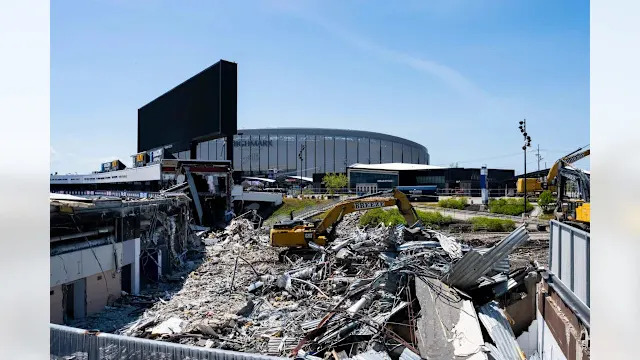
The future of the former site of Highmark Stadium is in flux as the old stadium comes down. While the initial plan to place parking on the former site was logical as a one-for-one replacement for the lots covered by the new stadium, the evolution of the site has created an opportunity for a more diverse use.
The Bills have already announced that the former administration building will not be demolished and now the Bills appear ready to join the redevelopment process around the new stadium. This should have been the case all along. The prior lack of development around the stadium has been well documented and there are numerous hurdles in front of both Hamburg and Orchard Park with the new stadium just weeks away from hosting its first event. This is especially true in Orchard Park, a town that has languished without any sort of interesting or useful development within their borders for decades. While the villages of East Aurora and Hamburg have enjoyed a surge in activity, Orchard Park has been largely stagnant with only an Olive Garden-adjacent restaurant to show for their efforts. It’s an uninspiring track record for those hoping that additional development springs up around the new Highmark Stadium.
Beyond being generally allergic to interesting development, Orchard Park also faces a difficult logistical challenge when it comes to redeveloping land around the current and former stadium. The vast majority of the land within the immediate vicinity of the stadium that isn’t already owned or operated by the Bills consists of residential properties. While the town revised their zoning rules to hopefully open up more opportunities, there aren’t many shovel-ready sites on the Orchard Park side of the stadium’s footprint.
Hamburg can offer much more flexibility. While the existing ECC campus buildings remain, there are acres of vacant land bounded by Big Tree Road and Southwestern Boulevard. In addition, the 1,000 foot buffer that has been set for lower height development in Hamburg effectively stops at the former ECC campus, meaning virtually the entire property from the campus to the corner of Southwestern and Big Tree would be a blank canvas to develop.
Things could change quickly in Orchard Park, of course. Despite the high asking prices on many of the homes near the stadium, it isn’t out of the question that a motivated developer could purchase a swath of land in order to pursue a larger development. Similarly, Hamburg could hit the gas on a master plan for their portion of the land in order to bring development online in a shorter period of time. The issue, in my view, is that any significant private development around the stadium is going to take time to get off the ground. There’s nothing to suggest that any site in Hamburg or Orchard Park could be ready for development by the end of 2027, let alone 2026. That’s a difficult timeline for anyone who had visions of complementary development being in place and operational if and when the Bills host the NFL Draft.
All of those factors exist outside the control of the Bills, which is why I was so surprised they hadn’t expressed a desire to lead at least a portion of the development efforts from the minute plans for the new stadium were released. Of all the things Terry Pegula has done since he arrived in 2011, running development projects have been one of his most successful endeavors. Haborcenter has been an incredible addition to downtown and the redevelopment of 79 Perry brought new office and restaurant space to the arena district. He stepped in to get the Heritage Point development over the finish line, which will be another important piece of the neighborhood around KeyBank Center. Why Pegula and the Bills didn’t want to be in the driver’s seat for developing the area around the stadium was perplexing. It’s encouraging that they’ve reconsidered their position and it could mean something more substantial arrives on a faster timeline.
One idea I had been fond of is no longer a viable option, but I think it’s still interesting and could have been pursued had the Bills taken the lead from day one: What if a reuse plan was put in place for the former stadium?
Imagine if the administration building was kept along with the former M&T Bank and Highmark clubs from the tunnel end zones. Those structures could have been strung together to create a Bills-focused hotel. The administration building has hotel written all over it and I’ll be shocked if it isn’t turned into a hotel now that it’s being preserved. Tacking on the club buildings would have offered more space in addition to preserving a more familiar silhouette of the old stadium for guests and fans alike.
My vision would have still removed the upper deck, bathroom towers, scoreboard, suites and scoreboard end zone seating, in addition to other portions of the lower bowl. But what if a portion of the lower bowl was kept in addition to the field? That space could be utilized on game days for tailgating and other fan activities and the field could continue to serve as a venue for youth and high school sports, making it a community asset for Orchard Park as well. That new hotel would have had the old playing surface (plus bits of the bowl) right outside the front door, in addition to the new stadium, of course. From there, other buildings and attractions could spring up, akin to Titletown or Patriot Place as have most commonly been connected to future development around the stadium, with the portions of the old stadium serving as a centerpiece of that development.
All of that is a pipe dream now that the majority of demolition on the stadium is complete and it appears that the Bills have some desire to get meaningful development rolling on the former stadium site.
Stringing together a development that unifies the Bills’ footprint on that side of Abbot Road is logical. A uniform campus that connects the Bills store, the fieldhouse and the old stadium site would serve as an excellent complement to the new building. As The Buffalo News reported, a pedestrian bridge may be part of those future plans, which would be an excellent addition on game days and beyond. It might even be beneficial for the Bills to construct two or three bridges to help handle gameday foot traffic and to provide another unique feature to the larger overall development. That Bills campus, if you will, has the potential to blend the sort of year-round amenities and attractions that have previously failed to crop up around the old building. It doesn’t need to be a replica of Titletown or Patriot Place, but both of them are good templates to consider. The mixed-use nature of Titletown seems like it would be a better fit than the retail-focused layout of Patriot Place. I would be concerned what the long-term outlook for a retail-heavy district would be once some of the allure of the stadium wears off. Whether it be through offices, residential or both, building that additional traffic will be a key factor.
The Bills shouldn’t hesitate to take on the task. Serving as the primary developer of the space ensures greater control over the design, the timeline and how the development will connect to the new stadium. They could also leverage their financial status to potentially attract more significant tenants. They’d also grant themselves vital certainty as it pertains to the rest of the site. The Southtowns haven’t historically been a heavy draw for development. Most larger retailers only move south after planting their flag in the Northtowns. There’s a mostly vacant mall about a mile away from where the stadium is being built. It shouldn’t be assumed that every acre of developable land will be home to a shiny mixed-use district.
Striking while the iron is hot, and exerting control and certainty over the planning and execution could be the most valuable piece of all. The Bills would be wise to push harder in developing that space.
 Two in the Box
I live in the area, on the Orchard Park side. That residential area you mentioned. Really what I think everyone is waiting on is the zoning. Talks did start back when the stadium was approved and in October 2024 they created the DR-2 zone. Apparently that wasn’t good enough and they contracted with LaBella to redesign the zoning AGAIN. Phase 1 of that plan completed, the immediate areas of the old and new stadiums between southwestern and big tree rd, but we’re still waiting on a public hearing for Phase 2 to even be scheduled which will include the rest. The town seems to want to micromanage the kinds of businesses that will exist in the area and with no concrete plans to increase year-round attendance with the new stadium I can’t imagine anyone wanting to snatch up land at the moment. Getting the Bills to put pressure on the Town and throw some cash around I think would be a good idea.
LikeLiked by 1 person
Thanks for the insight. I get the impression that the higher asking price on the various homes and properties may play a role since a developer would need to buy several of them, then pay to knock them down before moving forward on any plans. Meanwhile, the Bills portion of the property is basically wide open and ready for construction. Having grown up in OP, the town’s general lack of foresight when it’s come to any sort of strategic development of key areas. Obviously you need the private investment too from developers, but the common thread here is the town. IMO
LikeLike