The effort to make Buffalo a stop for Great Lakes cruises took a step forward this month as Erie Canal Harbor Development Corporation (ECHDC) put out an RFP for the design of a cruise ship terminal with a goal of opening Buffalo’s port to ships by 2027.
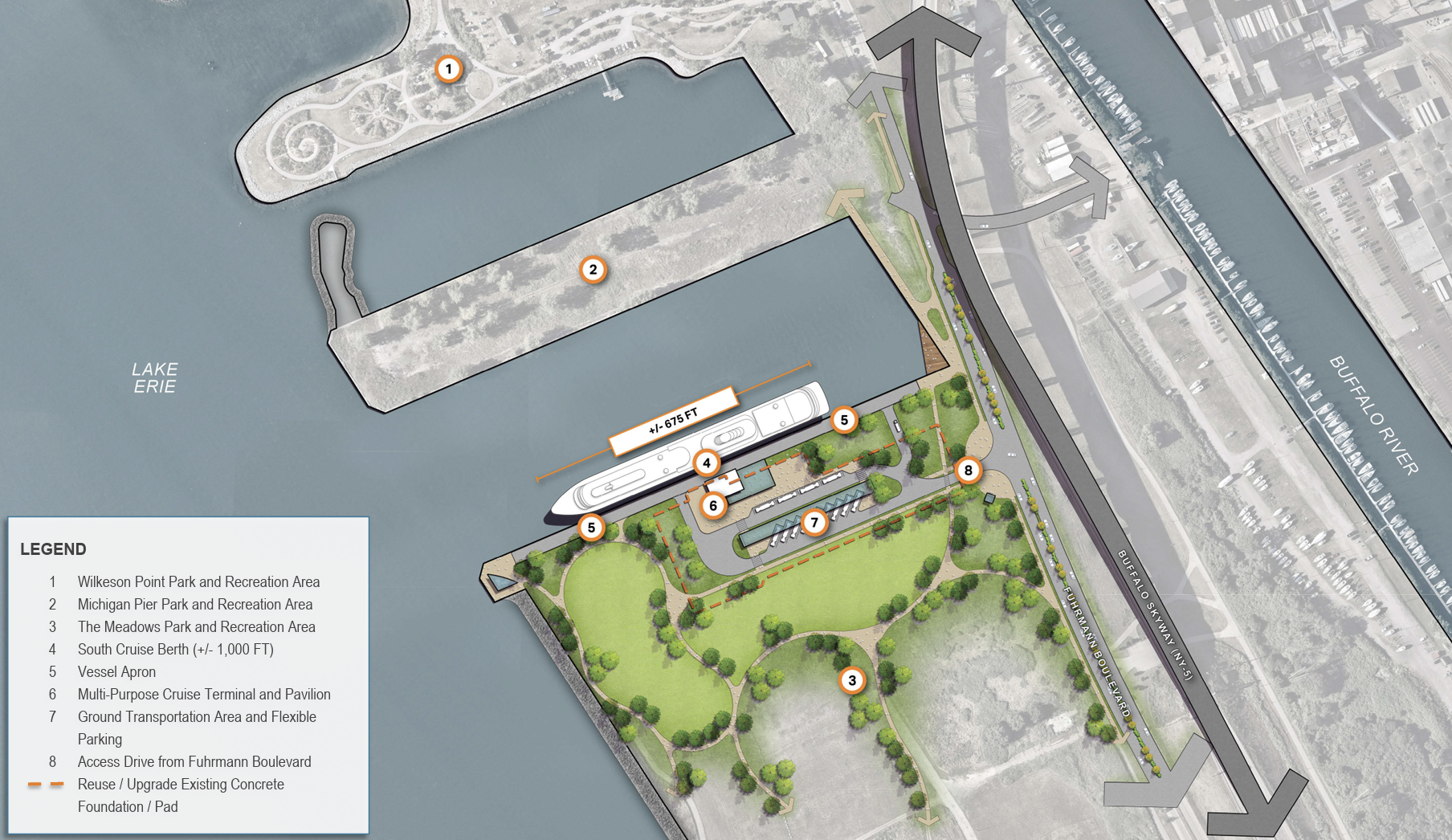
This is a significant step in the process which kicked off two years ago as ECHDC began studying the feasibility of bringing ships to Buffalo, ultimately looking at six different waterfront sites for the docking facility. The two most discussed locations were the redeveloped DL&W train shed or a location on the Outer Harbor, with the latter winning out as the preferred location for ECHDC.
The chosen location of Slip 2, best known as the former site of The Pier, is expected to provide the most flexibility for accepting ships, including the largest cruise ships on the Great Lakes. Reporting has also pointed to the ability to provide the necessary infrastructure for Buffalo to operate as a port-of-call and a home port. Infrastructure requirements include customs, sanitation, luggage processing and fuel storage. Space for some of those requirements would have been at a premium at the DL&W site, though a creative solution certainly could have been found. Based on the report, what may have been most damning for the DL&W and Canalside is the space available in that portion of the Buffalo River. The report details that the lack of space and difficulty in turning vessels (plus air draft limits due to the Skyway) in the river were among the biggest problems with selecting the DL&W for the terminal facility.
With ample space on land and within the breakwater, the Outer Harbor has far fewer barriers to developing the terminal facility and making Buffalo an attractive option as a home port for cruise operators. Just having the capability of making Buffalo a home port makes the Outer Harbor a strong choice. Any avenue that brings in additional tourist traffic to the city is worthy of exploration. Ensuring that Buffalo’s terminal isn’t just a stop along the way for cruise guests, but can also serve as a start or end point for a journey is a win.
Although the Outer Harbor location presents a more logical (and likely cost effective) path forward, I can’t help but lament the loss of not bringing these ships right to the heart of the city. Just picture heading down to Liberty Hound for a drink on a summer evening and seeing a 300-plus foot cruise ship docked alongside the DL&W with kayakers heading down the river and people enjoying Canalside. On optics alone, that makes for a very cool visual. There would be functional benefits as well. For starters, the Canalside location would have dropped cruise guests right in the city. Transportation to different activities would have been a breeze as there are a handful of things to do within walking distance and the new DL&W light rail station would connect them to far more options within the city. The cruise facility would also have provided a consistent tenant for a portion of the redeveloped facility, ensuring added occupancy for the sprawling development project. Arrival of cruise guests would have also aided in creating additional customers for the businesses that will eventually occupy the second floor of the DL&W space. Assume for a moment some sort of food hall or public market is built in the second floor of the terminal. Dumping a cruise ship’s worth of customers into that space on a regular interval would have made for a nice boost to business.
The opportunity to create an impressive and unique welcome to the city is what is lost by not selecting the DL&W site. Virtually none of the other ports utilized by Great Lakes cruise operators are especially impressive operations. Most operate out of small facilities with minimal footprints and many cities have the ships dock in industrial port areas. For example, ships that dock in Milwaukee do so in an area adjacent to the city’s water treatment facility. Of the more impressive locations, Detroit accepts cruise ships in a picturesque location along the Detroit riverwalk and Toronto’s cruise ship terminal appears to be the largest and most substantial standalone facility on the Great Lakes and is located near a significant project that will redevelop industrial port facilities into a mixed-use neighborhood. This is a long way of saying that Buffalo could have had one of the most attractive and unique terminal arrivals of any of the Great Lakes cruise cities.
It also means that Buffalo isn’t necessarily setting ourselves behind the competition by selecting the Outer Harbor location. In fact, by ensuring the largest ships won’t just be able to utilize Buffalo as a port-of-call, but that the city is an attractive home port is a wise decision. How the city and ECHDC overcome the drawbacks of the location will be of vital importance.
Slip 2 isn’t exactly close to anything of great interest to tourists. Wilkeson Pointe is an easy walk and offers some enjoyable activities, but even the Canalside bike ferry is just far enough to feel inconvenient. The same goes for Charlie’s Boat Yard, the small boat harbor and Lake Erie State park. Some city bikes or even rentable scooters could make those journeys much easier, though I suspect the typical patron of a Great Lakes cruise isn’t going to be overly eager to hop on a Lime scooter (which aren’t offered in Buffalo anyway). That either means shuttles, a water taxi or some other form of transport that makes the journey from this location on the Outer Harbor and into the city easier is a must.
The silver lining here is that, as stated above, few of the other stops throughout the Great Lakes have extremely impressive facilities devoted to their terminals. Buffalo will hardly be the only stop with a somewhat inconvenient location. In fact, even on the Outer Harbor, Buffalo’s location should feel more welcoming than those in Cleveland, Kingston, Milwaukee and Thunder Bay, just to name a few.
Work should begin immediately to offer the necessary support for the cruise ship terminal. Determining if shuttle bus service will be offered (and who would operate them), or if taxi and ride sharing services would be a viable option for cruise guests. The report illustrates space for coach buses. Are those the only – or primary – mode of transporting guest that will be needed? Buffalo had a water taxi previously, though it didn’t last. Can that be revived? You would think that a water taxi would be a valuable feature on Buffalo’s water front, so there would be some additional utility beyond serving the cruise terminal. Long term solutions like an at grade crossing should continue to be explored as well. Either way, options on how to get arriving guests from Slip 2 to the inner harbor, downtown, the AKG or any other points of interest needs to be a high priority.
If we make smart investments to support the cruise ship terminal, it will become a terrific addition to the city’s waterfront. Ensuring the success of this endeavor will rest with the stakeholders and decision makers on Buffalo’s waterfront. They should act now so their plans can roll out with the construction of the facility.
 Two in the Box