Building on the Sabres’ Canadian exploration

The Sabres have officially begun their Canadian Bacon mission of an invasion of Ontario. The goal isn’t to litter, but to establish a greater footprint for the organization in the golden horseshoe.

Ted Black, Danny Gare, Jay McKee and Ville Leino all took a trip through Ft. Erie and St. Catharines  that included visits to schools, hockey clinics and, naturally, Tim Hortons. Good on the Sabres for seeing the comedy in having Leino serve up donuts much like he did last season (see what I did there). Social Media Sam deserves some credit for her Ricky Bobby “I’d love to sign your baby” Instagram caption as well.

All kidding aside, the Sabres have taken a wise approach here. Obviously there are a ton of fans in Ontario that are ticket holders. While most of them either sell their tickets to fans of other teams or simply root for the Leafs, the Sabres have a significant portion of their patrons in Ontario. The same goes for the Bills, the Galleria and Buffalo Niagara Airport and most of Western New York.

Pulling from Ontario would occur even if the Sabres (and Bills) didn’t bother marketing themselves. It is just how sports fans will operate. For fans in Fort Erie and St. Catharines who don’t have a pro team in their city, having the Bills and Sabres a hop and a skip down the Q is beyond convenient. While Toronto is the obvious first choice for many of these fans, Buffalo provides a natural fit for sports fans looking to affiliate with an NHL or NFL franchise.

From a business standpoint, cultivating this fanbase and maybe even building upon it is an easy approach for the Sabres. What has changed is the proactive approach the team has begun to show. This type of physical outreach shows that the Sabres don’t just respect the contingent of fans they have from Ontario, they want to grow that fanbase.

This relationship could potentially have a positive effect on the rest of the Western New York sports scene as well. Continue reading →

Amerks seeing red for 2012-13

While Jhonas Enroth’s mask tweet was rather unexpected, the Amerks third jersey unveiling was scheduled ahead of time. In addition to their white home and royal road jerseys, the Amerks will wear a screaming red alternate uniform this season.

Amerks.com


They did it right, however. The uniform remained unchanged aside from the base color. The triple stripes on the sleeves and waist stay blue and white and the Amerks crest also sticks around. Aside from incorporating an alternate color, the Amerks kept their jersey largely unchanged.

Perhaps it is that red, white and blue are a pleasing scheme that can be used in any combination. The Sabres use of gold doesn’t necessarily allow for too many subdued uses. While a red uniform isn’t conservative (hello, butter knives), it complements the color scheme the Amerks use quite well. Gold, on the other hand, contrasts the Sabres (or Preds) use of navy in a much louder fashion. Yet, I’m left wondering if the Sabres third jerseys (due for 2013-14) will use gold as a primary color. Continue reading →

Talkamania 16 via Buffalo Wins.com

You may or may not be aware that I have been contributing some content over on Buffalo Wins.com. If you weren’t aware then start reading that site more often, we need some hits.

Joe had me come aboard for an installation of Talkamania in which we discussed all things Bills. In case you haven’t noticed, I have rededicated myself to offering a bit more Bills coverage this season that I plan to sprinkle in with the already abundant Sabres and hockey content I produce.

Check out the podcast, it is worth a listen for nothing other than the dulcet tones of Joe and myself.

Jhonas Enroth’s stunning new mask

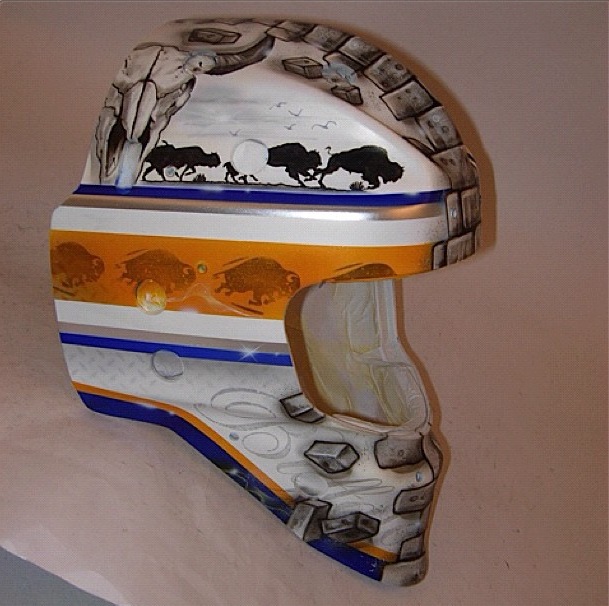
Jhonas Enroth, king of Instagram, has a new mask for the upcoming (hopefully) season. It happens to be totally awesome.

Enroth uses the world’s best helmet artist, Dave Gunnarsson (daveart), and has yet to disappoint with any of the artwork he has worn during his time in North America. His newest lid is a thing of beauty, perhaps the best helmet he will wear at this point in his career.

The brick wall art remains down the middle of the design with the Sabres primary logo prominent on the left side. On the right side is a combination of the jersey stripe form the white uniform, silhouettes of bison, Buffalo scripted on the chin and a badass longhorn skull.

Aside from providing the most vivid, sharp artwork on a mask, Gunnarsson’s specialty is working stripe patterns into his masks. This instance makes the blue, silver and gold stripes a focal point of the right side despite being the most basic portion of the artwork.

The buffalo from the primary logo adorns the gold stripe while silhouetted bison run above the upper blue stripe. Gunnarsson also worked a diamond plate pattern near the chin. However, the longhorn skull does it for me. Despite being relatively obscured towards the top of the helmet, it reminds me of a mask once worn by Grant Fuhr during his time here. That mask that Fuhr wore was my favorite Sabres mask of all time.

Combining this mask with the white bison helmet that Ryan Miller will wear ought to give the Sabres the best one-two punch of helmet artwork in the league.


Conjecture department: Could a lockout benefit the Sabres?

Might this lockout be a good thing? Not for the game or fans, mind you; but for the season.

When I look at the Sabres past few seasons, there has been a significant lull in performance at some point. Whether that came at the beginning of the year (2010-11) or in the middle of the year (2011-12), the team has suffered from a drop off that ultimately cost the team wins and position in the standings.

Obviously last year’s mid-winter slump was centered around injuries and horrible play, but fatigue and the grind of the season likely had something to do with it. Since it seems as if a lockout is inevitable at this point, could it be somewhat beneficial for the Sabres to play a shortened schedule?

Perhaps a shortened season would allow for Buffalo’s offensive players to stay fresh over the entire course of the season. The same would go for the goaltending and defense. In fact, shortening the schedule could be massively beneficial for Ryan Miller, whose workload would potentially go from 60+ games to 40+ games. That is, of course, if Lindy Ruff utilizes Jhonas Enroth properly.

There are a few permutations here that serve as counterpoints to this train of thought. First, a shorter schedule would also cause the league to condense games into a smaller package in hopes of keeping the 2012-13 season to an adequate length. This will cause more back-to-back matchups and could potentially create more wear and tear on the players.

Secondly, every team will be playing a shorter schedule. Because of that, every team will reap the same benefits from trimming the schedule down from 82 games. It’s not as if the Sabres are tailor-made to sprint as opposed to finishing a marathon or gaining any sort of added advantage compared to the rest of the league. Continue reading →

Three thoughts for the Bills schedule

In an attempt to offer some thoughts on where I see the Bills season going, I will offer three thoughts for each game of the year. Rather than giving a firm prediction for each game I will simply say what should be expected from the Bills.  Hopefully this offers a little different take as compared to your typical season preview. Continue reading →

Bills have options despite shortage at receiver

Food for thought: the Bills have four specialists, four wide receivers and four quarterbacks. You might say three quarterbacks and five wide outs depending on your point of view.

Regardless, the Bills enter week one with a very interesting set up in terms of their 53-man roster. Tavaris Jackson, Tyler Thigpen and Brad Smith are all filling a role behind Ryan Fitzpatrick as Buffalo’s signal caller. Meanwhile, only Stevie Johnson, David Nelson, T.J Graham and Donald Jones are the wide outs for Buffalo’s typically spread open attack.

Dorin Dickerson’s versatility may fill the Bills need for receiving depth.

The choice to retain Thigpen was obvious. Jackson, while a fine option to fill the backup role behind Fitzpartick, hasn’t learned the offense yet and would leave the Bills crippled if Fitzpatrick was injured early in the year. In addition, Brad Smith has a wonky groin and seems better suited as a receiver than quarterback.Smith’s groin could potentially keep him out of, or limited, against the Jets. There is still five days until kickoff which allows for plenty of healing time. Regardless if Smith plays or not, there is a better chance he will be contributing as a receiver rather than at QB (outside of wildcat plays).

What might be the best option would be to cut ties with Smith. He hasn’t proven to be worth the investment they made, particularly with so few spots available for gimmick tools (see: kickoff specialist). It might just be in the best interest of the team to retain Thigpen as a third string passer, cut ties with Smith and fill the vacant spot with a proper receiver from a practice squad, waiver wire or free agency.

It seems safe to assume that the Bills will not attempt to go through the season with just four receivers while carrying an equal number of quarterbacks. At some point they will cut ties with a signal caller to free up a roster spot for either a playmaker or some other position of need. In the short term, however, they do have some options. Continue reading →

Pegula Ice Arena progressing towards completion

This is a special guest submission from Kyle Rossi who runs the blog Thank You Terry. His blog is all about Penn State hockey – both club and NCAA – and is full of phenomenal information. I highly recommend reading it on a regular basis. Kyle was kind enough to offer some insight to the progress being made on the Pegula Ice Arena down in State College. Given the Sabres recent victory regarding the Webster Block, I thought there would be no one better to provide some insight on the scope of a Pegula funded project such as the PIA or the HARBORcenter. Enjoy.

Hey Sabres fans! My name is Kyle Rossi, and I write Thank You Terry, a blog covering the soon-to-be four hockey teams representing Penn State (men’s and women’s NCAA, men’s and women’s ACHA). As I’m sure you know, you and I both share a debt of gratitude to one rather wealthy man: Terry Pegula.

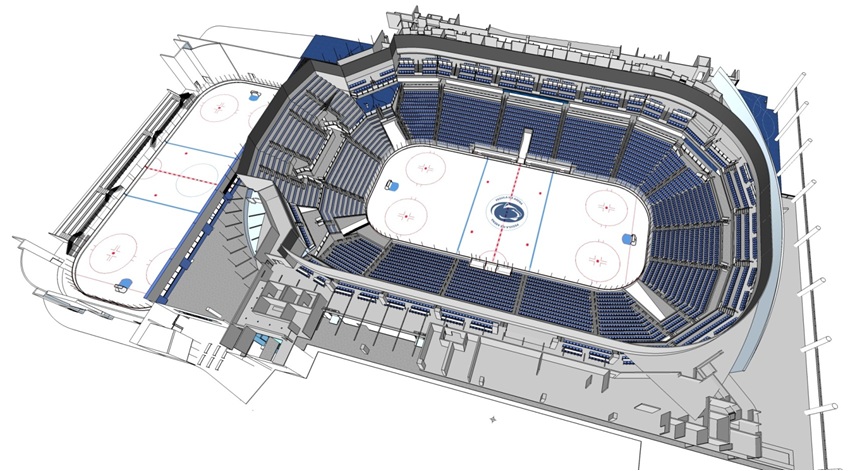
The rendering of what the finished Pegula Ice Arena will look like.

Our stories are actually somewhat parallel. While Buffalo was wandering through a purgatory characterized by an always-competitive team that never saw a free agent it couldn’t lose (or a scouting department it couldn’t slash) and therefore couldn’t take the final couple of steps, Penn State was dealing with its own sort of limbo. Our non-varsity teams, known as the Icers and Lady Icers, had been considered candidates to make the jump to the big time, NCAA Division I, for decades – if only the school could find some money for a DI-caliber hockey arena. Despite PSU’s glut of success in the ACHA (including seven national championships), the program’s rabid supporters were always just one “hey, when are you guys going DI?” from an outsider away from a feeling of hopelessness.

Suddenly, in swoops this billionaire nobody had ever heard of to write large checks and save the day. In the Sabres’ case, I suppose he wasn’t a complete unknown, but there still had to be a “wait…this guy’s a Sabres fan…and he wants to buy the team?!?” moment for you guys.

Anyway, Chris invited me to write this post to update you on the progress of something possibly of interest of you, the arena bearing Pegula’s name on Penn State’s campus.

You might be familiar with some of the widely-reported basics. There will be two NHL-sized sheets, one in what’s being called the Community Rink, which will have 300 seats, the other in the main arena, which will seat 6,000. Five thousand of those seats will be arranged in a single-level horseshoe, with a ring of suites above the open concourse that will be at the top of the “regular person” seating. The final thousand seats will be the student section, to be located behind the net Penn State will attack twice. It will be as steep as code allows, helping to meet the one major directive Pegula has given on the project, that the building “sound like a hockey game inside of a garbage can” on game days.

“It should sound like a hockey game inside a garbage can.” Terry Pegula

The price tag – $89 million – is absolutely staggering for a college hockey facility of its size. For context on that, one only needs to consider some of the venues toured by a Penn State contingent (including Pegula) in 2010 to generate design ideas. Notre Dame’s Compton Family Ice Arena, which opened last season, cost about $50 million. Miami’s Goggin Ice Center cost $35 million (in 2006). Minnesota-Duluth’s AMSOIL Arena opened in late 2010 at a cost of $38 million, while RIT’s proposed Gene Polisseni Center, the most likely candidate to replace the Pegula Ice Arena as the newest in college hockey, is estimated to cost around $35 million. Basically, if Penn State gets anything approaching dollar-for-dollar value on this project, it will instantly become the crown jewel of college hockey. Continue reading →

Might a new UB stadium spark something bigger?

I was previously inspired to write about UB’s football program due to my desire to see a true Division 1 college team in my hometown. The Bulls were close at one time, but still have some work to do.

During the time I spent thinking about that previous post, Brian Koziol and Mike Harrington were discussing the Big East’s hope for a 14th team. Their conversation evolved into a discussion over UB’s stadium and the shortcomings the building has.

Upgrade me, please.

UB Stadium is just about 20 years old and has a much younger, albeit unimpressive, addition on the north and south ends. It its current state – replete with Jacksonville-style trap advertisements on the north end – the stadium holds just over 29,000 people. That is an average number for a stadium that houses a team whose fan base is quite small. Filling it, however is a completely different problem. As detailed in that previous post, in-roads need to be made to establish the legitimacy of the Bulls in the Buffalo sports market. Truthfully, this team should be no lower than third in priority behind the Bills and Sabres. This is a DI football team that seems to get equivalent treatment to a double-A baseball by many.

Improving non-conference competition and providing your head coach the appropriate amount of time to build the program are vital parts of taking UB to the next level But if the digs aren’t up to snuff, big conferences and fans that is on the fence may not be lured towards the Bulls.

UB’s current set up is by no means old. But it is severely below the standard for most DI programs. An ideal situation would bring about a new facility to house the football, track and soccer teams, but finding that kind of funding is going to be next to impossible. As of now, the only changes due to the stadium under UB2020 is the removal of the – now tarped – north bleachers. That will make room for an indoor facility which is a wonderful recruiting tool, but it doesn’t do much for the glorified DIII stadium that stands at UB North today. Continue reading →

Can UB football find more respect?

Once again, college football is in full swing and all is right with the world. It is funny that most people in Buffalo still seem to care very little about the UB Bulls program. Despite the lack of general interest and fan support, DI college football lives in Western New York. However, it has yet to find a way to thrive.

The Bulls haven’t really done much to help their cause. Outside of the Tuner Gill era, this has been a program mired in mediocrity that has often inched towards downright pathetic. The early years were obviously thin as was expected when trying to make the jump. But it seems unfortunate that the team never gained momentum from their MAC Championship and bowl appearance. Perhaps the blame lies outside of the stadium walls.

Buffalo has always prided itself on being a football town. Yet the Bills seem to be the only team that fans have any interest in. The Buffalo News is fighting the good fight for this team and providing adequate coverage. However, the paper seems to be the only media outlet giving much attention to the team.

It is understandable that the battle between a college football program, the whiner line and candy drafts is a difficult one. At the end of the day I would imagine D1 football finishes a distant third from those two radio programming staples.

What would appear to be the biggest problem is two-fold. The team struggles to hit the .500 mark in most seasons while battling major perception issues from fans and area media alike.

The first issue is strictly fact. Aside from the success Turner Gill built, the Bulls have been quite average for their entire time playing with the big boys. Of course, that isn’t for lack of trying. They schedule big name teams for those early season pay days with hopes of constructing the framework to build the program on. However, it would seem as if there is also a perpetual state of recycling happening here. At some point the program will need to take the next, necessary step forward. Until they do, finding their rightful footing (truthfully they should slot in right behind the Bills and Sabres) in the Buffalo sports landscape will be a battle.

The second issue is simply a misconception of the football being played by UB. Just look at their MAC Championship season. They were ultra-competitive in the MAC and even managed a few upsets along the way. That first bowl berth was a great step to take, even if the end results pushed Turner Gill to a job with a more respectable school. Playing in the MAC is a big part of the issue for me. As someone who likes just about any form of college football, I’m cool with it. Mid-major conferences produce great competition and the occasional stud prospect. For bandwagon fans, however, it just doesn’t register. Continue reading →