Let’s start with the obvious. This wasn’t going to be a sweep. No matter how good the vibes were after game one, this was going to take more than four games to settle. Now, the series goes back to Boston at 1-1 after the Bruins cruised to a 4-2 win in game two.
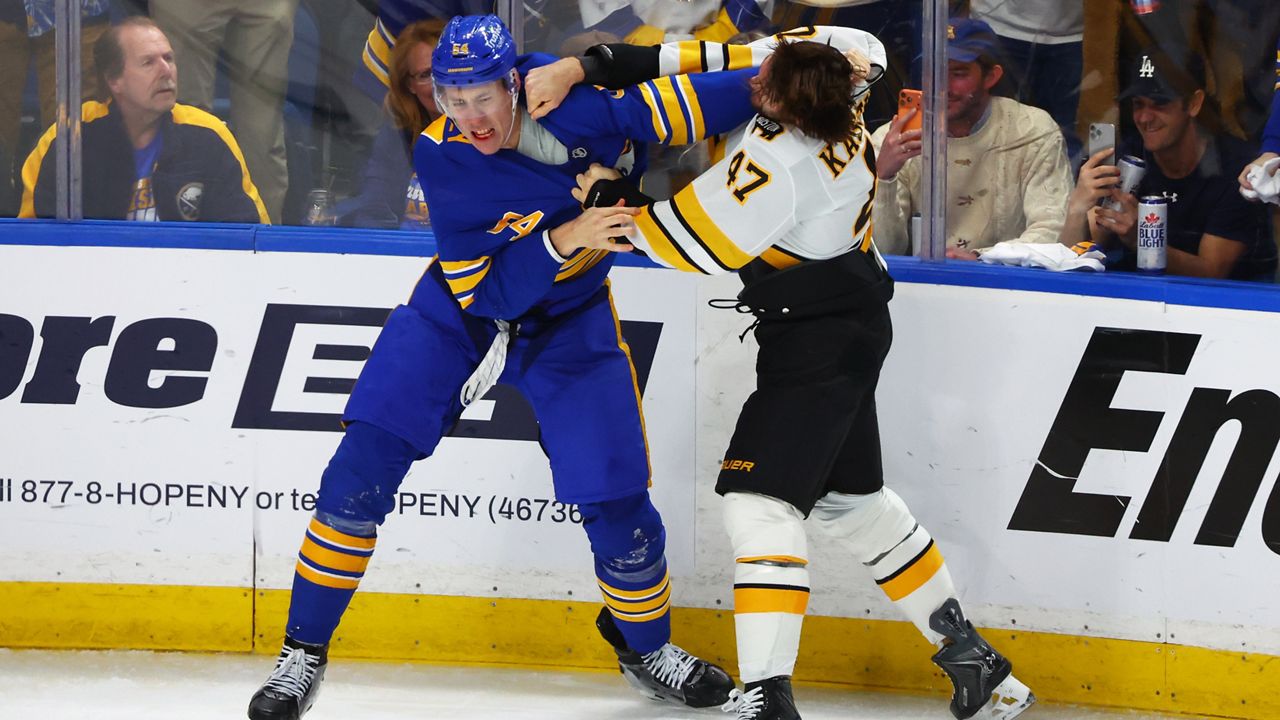
It was the Bruins turn to be the imposing team after the Sabres were the better side in game one. Boston choked out Buffalo in transition and eliminated the forecheck that allowed the Sabres to maintain an impressive level of pressure in game one. The Sabres played a role in that as well, exhibiting a level of sloppiness in possession that was absent on Sunday. But the Bruins deserve credit for countering what made the Sabres so impressive in game one and exerting control for large portions of the game. David Pastrnak picked up two more points along the way. That’s two multi-point efforts for the Bruins’ star and five points total in the series. He’s been a difference maker.
Score effects will make Buffalo’s shot totals look favorable, but they were held in check for most of the opening 40 minutes. A good encapsulation of Buffalo’s struggles to generate looks came in the second period. Opening on the power play, the Sabres registered a shot 39 seconds in courtesy of Tage Thompson. Buffalo’s next shot didn’t come until the 10:34 mark (also a Tage Thompson attempt on the power play). The two shots from Thompson were the only two of the period to come from inside 10 feet. Buffalo’s other six shots came from 36 feet or further away.
Buffalo’s start wasn’t all that bad. They had a similar energy that they brought to game one and were creating havoc on the forecheck as a result. Then, Nikita Zadorov took an extra minor in a scrum and Buffalo’s putrid power play played two uninspiring minutes and all the flow and aggression got sucked out of their game. Jokes about declining penalties have been well worn over the years, but this power play, now 0 for their last 31, has been so damaging to their ability to win games. They’ve played two games without scoring in the opening 40 minutes. That’s a hard enough challenge to overcome. To do so with a power play that it so ineffective is problematic.
Is It Still Luukkonen’s Net?
I try not to be too alarmist with goaltending takes, so I’m on the fence a bit regarding the decision Lindy Ruff will face on Thursday. Does he give Ukko-Pekka Luukkonen one more opportunity or does he turn to Alex Lyon? I explored this a bit heading into the playoffs, and my gut says you’ll see Lyon get the start on Thursday. Had this been a more standard fare loss, I’d expect to see Luukkonen again. But the half ice bouncer was egregious and he didn’t look all that much better on the other three goals. He’s made some big saves in the series and started this game with more confidence than he did in game one, but he hasn’t been super sharp thus far.
His play is magnified by Jeremy Swayman at the other end. Swayman has played 40 perfect minutes in both games while Luukkonen has been beaten four times over the same span. Add in the lowlight goal from tonight and it shouldn’t be a huge surprise if Ruff opts for a switch in game three.
0 For 31
Thirty one-straight power plays have come and gone without a Sabres goal. There is no plan, no flow and no execution on the power play. I can’t imagine there are too many people left with faith in the extra man unit. It’s more telling to me they went the entire season without a five-on-three goal than whatever hot streaks kept them out of the bottom five in league-wide efficiency.
At this point, the problem goes well beyond Xs and Os. Their zone entries are horrific and on the odd chance they actually get set up, they’re incapable of generating any opportunities. Their best chance on Tuesday came from an individual effort from Thompson, which is about all you can expect lately. Unless there is a broken play, or someone makes a great individual effort, they’re probably not going to generate much. This Sabres system does not create any two-on-one opportunities, which makes it easy on the penalty kill to maintain high pressure on the puck. Boston knows if you push out hard on the puck carrier, the Sabres will panic and throw the puck away.
Buffalo’s play before their first power play and after it couldn’t have been more stark. Their lifeless power play sucked any juice they had from a lively opening five minutes and they remained flat until late in the third period. This tweet does a good job showing just how drastic the shift in the game was prior to Buffalo’s first power play and after it:
There’s no easy answer for this power play. At times, the second unit looks a little more lively. A little more threatening. But they don’t have nearly enough finishing talent on that unit to be a true threat. My stance on the power play remains the same as it has for months. Without a true shooting or playmaking threat on the right wing, teams can overload their penalty kill to pressure Rasmus Dahlin and Thompson. Noah Ostlund is the easiest plug and play option they have. He’d be a welcome change over Josh Norris who is little more than a warm body over there. The easiest swap is dumping Norris in favor of Ostlund. If you want to get crazier, what about Bowen Byram at the top of the unit with Dahlin on the right side? He’s their best playmaker and has a solid shot. He might be the best option they have for that right flank. I’d also rotate Jason Zucker and Jack Quinn off that unit and try a grouping of Byram, Thompson, Dahlin, Ostlund and Josh Doan. That group may be equally ineffective, but at least it would show they were trying something different.
Striking First
There was a moment that may go overlooked given how the following 59 minutes went, but Tage Thompson skated into a loose puck just above the left circle and ripped a shot that Swayman handled with relative ease. It was about as perfect of a sequence as you could draw up for the first shift. The Sabres disrupted Boston’s breakout and created an offensive zone turnover that put the puck on the stick of their best forward with time and space. I can’t begin to imagine what it would’ve been like in the building had Thompson wired the puck past Swayman as opposed to hitting him in the chest.
The Sabres have been good to open both of these games. They got away from their game on Tuesday, but their opening five minutes was good. They created chances but didn’t capitalize. That’s been the theme in both games thus far and it cannot follow them to Boston. It is crucial that the Sabres not only continue to start fast, but to actually capitalize on a chance early on. I don’t expect them to win another game this series if they keep waiting until the final 10 minutes of each game to start scoring. It is imperative that they score first and play with the lead in game three. Not only would it do wonders for their confidence, but it will help prevent the Bruins from grinding their transition to a halt.
Transition Success
The Sabres were dogs on the forecheck in game one and they had a fair bit of success in transition. I wouldn’t give them full marks – the Bruins have sniffed out practically every cross-ice pass the Sabres have tried to make in the neutral zone – but they were effective in all three zones in game one. That was clearly not the case in game two. Buffalo will need to carve out some space in transition if they’re going to take back the series lead in game three. That has to start with cleaner puck touches. The Sabres were extremely sloppy in game two which fed into the Bruins’ success on the forecheck. Buffalo also created some mismatches with their speed in game one which they didn’t in game two. Attacking with speed and being tidy with the puck are two huge keys for the Sabres to get back to what has made them effective.

