In a year when virtually everything had to go right for the Sabres, it feels like it’s all gone wrong.
As the Sabres prepared to open training camp for the 2024-25 season, the club was banking on a lot of things to go right in order to break their playoff drought. There weren’t too many constants to lean on from the prior campaign while improvement from the young core and better health were among key talking points for a team desperate to break their playoff drought. In a way, it felt like this was a season of “What if?” Or “If ____, then ____.” At the halfway point of a year that has been defined by a 13-game losing streak, it’s hard to say that anything Kevyn Adams and the Sabres had gambled on have paid off. In some respects, it was fair to be optimistic about certain aspects of the club. While other decisions seemed questionable at best. Little has worked for the Sabres this year, including some of the key tent poles from a pivotal summer.
How Do Key Players Bounce Back?
Perhaps the most notable aspect entering this season centered around the health of Tage Thompson and, to a lesser extent, players like Jack Quinn and Mattias Samuelsson. Alex Tuch’s production also regressed in 2023-24, drastically impacting the production of two-thirds of the team’s top line.

Despite his lingering wrist and/or hand issues, Thompson managed to remain an impactful contributor last season. While his production dipped, he found a way to make better impacts defensively and contributed a more well-rounded game in the absence of the highlight reel goals that had defined the prior two seasons. Whether or not he’d recapture that form would be a focal point to Buffalo’s outlook this year. While he was kept off the scoresheet in Europe, he began piling up points upon his return home. Thompson recorded at least one point in 12 of 13 games from October 12 to November 11, with 17 points (10+7) in that span. But Thompson has again missed time, picking up an injury against Montreal on November 11 that kept him out until the end of the month. Lindy Ruff just recently said Thompson is still dealing with the injury after being moved to the wing in what I can only assume is a step to mitigate the impact the injury has on his abilities at center.
While Thompson’s impacts remain elite, his injury has kept him off pace for the sort of high-end production many were expecting from him. He’s scoring at a 40-goal pace and is just shy of a point-per-game, though that’s still a far sight from the 94 point season he continues to be judged by. It’s hard to simply judge him off point production considering his underlying impacts. Big picture, the Sabres would benefit greatly from Thompson eclipsing the 80 or 90 point plateaus, something that will be difficult to reach should this injury linger further.
Alex Tuch hasn’t missed any time for the Sabres this year, and has managed to remain a quality piece of the team’s top line. Like many of his teammates, his inability to hit the net has been problematic, though he’ll be flirting with another 30 goal season if he keeps his pace from the first half of the year. I would contend a lot of his production will go as Thompson does, so the odds at Tuch coming close to his 79 point career high are likely a long shot, but that doesn’t suggest he hasn’t improved as compared to last season.
Tuch has certainly been more reliable than Jack Quinn or Mattias Samuelsson. The latter of whom has already dealt with another lengthy injury absence. Quinn, along with Dylan Cozens, was expected to reinvigorate the team’s second line and re-inject firepower into the middle six. The pair had a strong track record of success, so it stood to reason that the Sabres would benefit greatly from having Quinn back for a full season. Instead, Quinn has become acquainted with the press box and is now spending time on the fourth line. Both he and Cozens have been plagued by turnovers and poor finishing. The pair has been nothing short of a disaster at even strength, being outscored 13-9 and only carrying 41% of the expected goals. Even attempts to recreate The Kid Line that showed so much promise two years ago have fallen flat. And that’s indicative of the larger trend with respect to the players that were being counted on to bounce back.
Tage Thompson has not remained healthy, meaning another season with an asterisk next to his counting stats, Alex Tuch has been improved but he’s still fallen short of the career-best numbers he posted two years prior. Meanwhile, the likes of Cozens, Quinn and Samuelsson have not been able to recapture the form that made Buffalo’s young core seem so promising just a couple of seasons prior.
Can Buffalo’s Youth Take a Step?
Much of the answer to this question is listed above but Dylan Cozens, JJ Peterka and Jack Quinn needed to progress to make Buffalo’s forward group more well rounded and dangerous in attack. To this point they’ve fallen well short of that goal. There was hope that after a strong spell in Rochester, Devon Levi would be ready to return to the NHL. It only took six starts before he was returned to the Amerks for more seasoning.
However, both Zach Benson and Jiri Kulich have been bright spots. Benson’s rookie season showed a great deal of promise, and an improvement in finishing from him could have given the Sabres yet another wrinkle within the forward corps. His finishing hasn’t leveled up although his underlying metrics indicate he’ll remain a reliable contributor for the foreseeable future. Similarly, Jiri Kulich has carved out a role for himself. I would have put him firmly on the roster bubble in camp but thanks to continued injuries, he’s had the opportunity to stick. Now, given a fully healthy contingent of forwards, I can’t envision a reason to take him out of the lineup.
It’s been refreshing to see Kulich begin to deliver on his promise and for Benson to continue to show he belongs in the NHL. But it’s been equally frustrating to see so little from the more established members of Buffalo’s young core. Virtually across the board, Buffalo’s young players haven’t delivered the way they would have needed to in order to put the Sabres over the hump. That isn’t all on them, as the team has made a concerted effort to rely on young, developing players in key positions. Better veteran insulation, or an acquisition that would allow for friendlier deployment could have gone a long way for this group.
What is the Impact of the Reshaped Bottom Six?
Of the goals Kevyn Adams stated at the start of the offseason, reshaping the team’s bottom six was the one he made the most progress with. By bringing in Nicolas Aube-Kubel, Sam Lafferty and Beck Malenstyn, his goal of finding a stronger identity for the bottom six was on its way to being met. Ryan McLeod was expected to give the Sabres a better look at certain matchups and on paper the group of Aube-Kubel, Jordan Greenway, Peyton Krebs, Lafferty, Malenstyn and McLeod had the mix to give the Sabres a much different look at the bottom of the lineup.
There were question marks from the jump. Malenstyn, acquired for a second round pick, had dreadful underlying metrics aside from being quite fast and willing to hit just about everything. Lafferty’s underlying impacts weren’t much better, meaning that two-thirds of the fourth line had a history of chasing in possession. That has carried into the season, with Lafferty being one of the team’s worst possession players and being generally invisible when he’s on the ice. Malenstyn has been more than willing to throw his body around, but it hasn’t translated into possession for the Sabres either. The trio of Aube-Kubel, Lafferty and Malenstyn have only played together for 28 minutes at even strength this year but to strong underlying results. Remove Aube-Kubel from the picture and the numbers tank.

Other combinations with Lafferty and Malenstyn get similar impacts. That pair in particular are routinely out shot, out chanced and outscored when they’re on the ice. To boot, there hasn’t been any sort of upward influence to make the Sabres any Harder To Play Against from the acquisitions. The same questions continue to be asked of this roster all while playing a fourth line with a pair of players who kill the team in possession whenever they’re on the ice.
Can Lindy Ruff Push the Right Buttons?
Ruff’s return to Buffalo seemed like little more than a formality for the Sabres’ front office. There was little in the way of reporting on a substantial coaching search and Adams effectively said as much when pressed during media availability, saying he had someone in mind for the sort of accountability the players were asking for. Re-enter Ruff and a staff of assistants hand picked for him by the GM, an odd arrangement to be sure, but still celebrated by fans desperate for a return to the good old days. Now, 41 games in, I’m hard pressed to see many areas where Ruff has managed to improve this team. They have managed to do away with the poor starts that plagued them throughout 23-24. Though they’ve managed to replace them with an apparent allergy for finishing games in which they lead. Buffalo’s 11-8-5 record when scoring first is laughable (they were 25-9-2 last year) for a team that wants to be taken seriously.
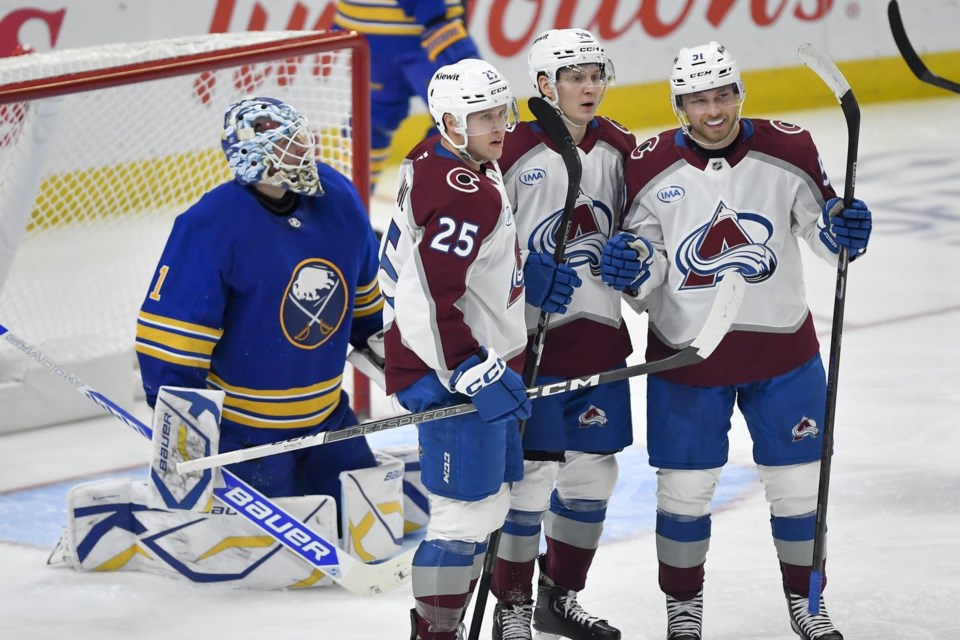
It will be hard to pick between the two embarrassing losses to Colorado and the losing streak as the enduring image from this season. When reflecting on those three events, I can’t help but wonder exactly what kind of accountability the players were looking for last spring and what it is that Ruff and his staff have brought to the table.
The Sabres are trending to finish below last season’s 84 points, their special teams have been stagnant (though the power play has been hot lately, hopefully they’ve turned a corner), and the young players haven’t progressed. Want to have a juicy barstool debate? Ask if Lindy Ruff is to blame for the up and down play from the likes of Jack Quinn, Dylan Cozens or even Owen Power.
There is no question that there are considerable flaws on this roster, but Ruff’s influence thus far has been to helm a 13-game losing streak, coughed up leads and a pace below that which cost the last coach his job. Safe to say he hasn’t found the right buttons.
Will the Power Play Improve?
As of this writing the answer is yes! Buffalo closed the 23-24 season at 16.6% with the extra man, good for 29th in the NHL. After their win against the Capitals, the Sabres are now 24th with an 18.3% power play success rate. It’s hardly a revolutionary improvement, especially when you factor in the two dreadful stretches the team experienced this season (0-22 to open the year and 2-33 during the losing streak). It’s safe to say Seth Appert still has his work cut out for him.
The power play has been strong as of late. They’ve scored at a 35% clip since snapping their losing skid with seven goals on their last 20 attempts. More importantly, they’ve done in through strong, in-zone play. These haven’t been fluke goals off the rush or broken plays, the Sabres have been far better at manufacturing dangerous opportunities, something that couldn’t be said earlier in the season.
Unfortunately, the damage may already be done. The Sabres only had a 14.1% success rate prior to this hot streak and combined with penalty kill that is operating at 77.8%, their special teams aren’t any better on balance than they were in 23-24 when the units played a key role in keeping the Sabres from the playoffs.
What Does Kevyn Adams Do With His Unused Cap Space?
The decision to buy out Jeff Skinner was perfectly acceptable, though it didn’t come without some risk. Simply buying him out and not leveraging the benefit of the extra cap space opened for this season would have been foolhardy. Kevyn Adams has gone on and on about the need to plan ahead and reserve their open cap space for future extensions, while ignoring the fact that the greatest benefit derived from buying out Skinner comes this year, when he had no additional extensions to hand out.
To compound the problem, none of his players have played to a level that would be deserving of a significant raise that might upset Buffalo’s cap structure. Short of Bowen Byram, none of the team’s pending restricted or unrestricted free agents are due a high AAV deal. In fact, two of the prime candidates for a big payday, JJ Peterka and Jack Quinn, have underwhelmed to the point where they’ll almost certainly get a bridge deal from Adams. This one year window was a prime opportunity to get a player (or players) who could help now. Unless the GM meant something else with his “time is now” comments from the offseason. It’s been noted many times that just finding another version of Jason Zucker would have sufficed. Finding any defenseman not named Henri Jokiharju to fill out the defense would have been an upgrade as well. Instead he’s being paid a hair over $3 million to be a liability any time he gets out of the press box.
Either by design or an inability to close one final deal, the Sabres are skating through what was to be a pivotal season with a gaping hole in their salary structure. Factor in all the other holes they’ve been unable to plug and it paints an ugly picture.
 Two in the Box
curious given its 3 year rolling WAR how much he is projected to have this year.
LikeLike