If all goes according to plan, Buffalo will be home to a new pro soccer team by 2026 and there’s some expectation they’ll be playing downtown.
News coverage of the plans to bring a USL Championship franchise to Buffalo indicate there is heavy lifting to be done in order to secure funding for the franchise and to get a stadium built. Getting all of that done before the summer of 2026 sounds like a particularly challenging task. Logic would dictate that if everything else is accounted for, the team will play at a temporary home while their new digs are constructed. Western New York isn’t short on adequate sites and while it may lack any semblance of character or charm, UB Stadium seems like an adequate solution for that first season or two.

Figuring out where the stadium will go makes for a fun conversation as The Buffalo News notes the desire for the stadium to go downtown. The capacity figure of 10,000 referenced by the News is encouraging for a number of reasons. First, it would make for a terrific atmosphere at full capacity for USL games. Second, it’s right-sized for the void between in the area’s concert venues. The imbalance between smaller venues, the arena and stadium make it hard for many acts to hit WNY unless they’re playing Artpark or Darien Lake. Even if the capacity was only 7,500 for soccer, this would become an ideal venue for summertime concerts. That size also makes this ideal for events like the Chicken Wing Festival (which seems to be dwarfed by Highmark Stadium) and high school playoffs and championships, giving even more opportunity for this to serve as a community asset.
Stadiums in the USL really run the gamut in terms of design and function. There are a lot of open-air soccer stadiums but quite a few shared venues and converted baseball stadiums. Colorado Springs has a very impressive venue that opened in 2021 at a cost of $42 million. Milwaukee is in the process of building a venue for their upcoming USL franchise that is stunning. Milwaukee’s Iron District Stadium is precisely the type of venue I hope to see built here (minus the hotel and housing element). The street-level activation would make this a terrific fit for a number of neighborhoods around the city and the intimate design and covered stand allow for a variety of events to be hosted, an ideal fit for Buffalo.
It’s encouraging to see downtown suggested as the destination for the stadium, but where exactly might it go? There are a few spots within the city which ought to garner attention, with some far more favorable than others. Some of these are more realistic than others as well. This list is meant to encourage some thought and conversation over where this stadium can, or should go.
Outer Harbor
I imagine this will be a fairly popular suggestion given the ample space available for development. Traffic bottlenecks and the lack of public transit options would cause headaches, as they have with concerts. My primary concern with considering the Outer Harbor is the lack of cohesion a stadium would have on that land. Now that the amphitheater is set to open, the comfort station and restrooms are complete and considering projects like Wilkeson Pointe and the bike park, the Outer Harbor doesn’t feel like a good fit for a stadium. Not only are most (read: all) projects suggested for the Outer Harbor met with vigorous opposition, but it is becoming clear that the Outer Harbor’s best use is as an expansive waterfront park. Allowing the Outer Harbor to be developed as a natural asset wouldn’t just appease the worrywarts, but it would allow our best effort and attention to be directed to other areas of the city that need developing, like Canalside.
Besides, a stadium on the Outer Harbor would be on an island with little to no other businesses or assets to tie into the development. The most logical parcel would be down on the site of The Pier, which would put the stadium a fair distance from the only parcels where further development could occur – the former Freezer Queen site where Gerry Buchheit’s condo project was unfairly shot down and the Terminal A site. I suppose you could make something work on the site of the Terminal A building and the expansive parking lot that borders the amphitheater and bike park, but that feels like a pretty heavy lift given that you’d need to demolish Terminal A to make it work. That’s a lot of effort and money that would need to be devoted to a site which would almost certainly be met with substantial pushback from various community groups. Better to find a site with more sufficient transit options and fewer potential roadblocks.
Central Terminal
Speaking of places likely to trigger a response from the preservation community, the Central Terminal would certainly offer a unique backdrop for Buffalo’s USL stadium. There’s quite a bit of space to play with around that property, though rail rights of way would be a hurdle depending on the footprint of the stadium. But if there was a desire for some sort of anchor to accompany the Central Terminal reuse, this could be a consideration. It’s even on the right of way for a metro rail extension.
Realistic? No. But from a blue sky perspective, it would be pretty cool if one corner of the stadium was the Central Terminal’s tower with the main terminal building serving as an entry point to the concourse. It would be one of the most unique stadiums of any sort in the country, let alone the USL. But there are better uses for the Central Terminal (some we’ve missed out on) that would do more for the surrounding neighborhood than a stadium could offer.
Larkinville
A very cool area of the city with a few large parking lots asking to be developed. One interesting space would be the site of the former Larkin Administration Building, a site that would throw the Tielmans of the world into a tizzy. That lot is probably too small support a stadium as you’d need to close down Swan St. and take a number of homes in order to make a viable stadium footprint. However, where there is a lot of space is on the other side of the district, in front of the Larkin Building. The surface lot at Van Rensaleer and Exchange has the room (though some of the homes on Roseville may interfere depending on the size of the venue) to accommodate a stadium like some of the more modern, soccer-specific stadiums in the USL.
This space would be highly visible from the 190 and wouldn’t be far from a light rail stop if there is ever a future plan to extend the Metro through Larkin on the way to the airport. Even without this lot, there would be ample parking throughout the district and you have multiple points of access via city streets and nearby onramps. The building could tie into the surrounding area’s architecture and with the growing residential population in that district, it could make for a very cool complement to one of the city’s cooler districts.
Ohio St.
If a downtown site is indeed chosen for this stadium, having multiple points of ingress and egress will be necessary. Even at a smaller capacity, plugging this in where there’s only one way for fans to get in and out would be a mistake. It’s why I feel the Outer Harbor doesn’t make much sense as an option because while you have north and southbound access points via Route 5, you’re still forced to funnel traffic down Fuhrmann Blvd., which all but eliminates the benefit of the four-lane highway that runs parallel to the street.
With that in mind, Ohio St. is a touchy option as the road isn’t an ideal fit for the sort of traffic a 10,000 seat stadium would generate. However, the infrastructure near Ohio St. is capable of handling such traffic. Despite some protests, post-game traffic out of Sabres games is pretty smooth and that’s thanks to the ease of access to the 190, city streets, the Skyway and the Metro. An Ohio St. stadium, likely on the parcel of land across the street from Resurgence Brewing, wouldn’t be on top of that infrastructure, but it’s not far either. Given the summertime schedule of North American pro soccer, it would be interesting if a portion of Ohio St. was closed to car traffic on game days. It would function a little bit like Abbott Rd. does right in front of Highmark Stadium, a quasi pedestrian mall that would allow fans to stream into the stadium from the parking lots in Cobblestone or the Metro.
I believe the parcel I’ve mentioned is owned by Ellicott Development, so that could conceivably create some challenges in site acquisition, but from the perspective of the space, fitting a stadium in the land bounded by Chicago and Moore would make for a cool venue. It would have views of the river and grain elevators and it’s right around the corner from Canalside and the arena. Plus, the residential that’s been built, and can be built, along Ohio (and in Silo City) means that a community could conceivably sprout up around the stadium in the years to come.
Ganson St.
All of the pros and cons of an Ohio St. stadium apply to Ganson St. There would be challenges in traffic control, especially for those who want to park right on top of the stadium. The operations of General Mills and Archer Daniels Midland would make it difficult, if not impossible to shut down the street to traffic on game days. However, the space on Kelly Island immediately adjacent to Riverworks would be an ideal home for a stadium of this size and, for my money, it trumps whatever issues could exist with access. Some of those issues could be solved by a pedestrian bridge that connects Kelly Island with Ohio St.
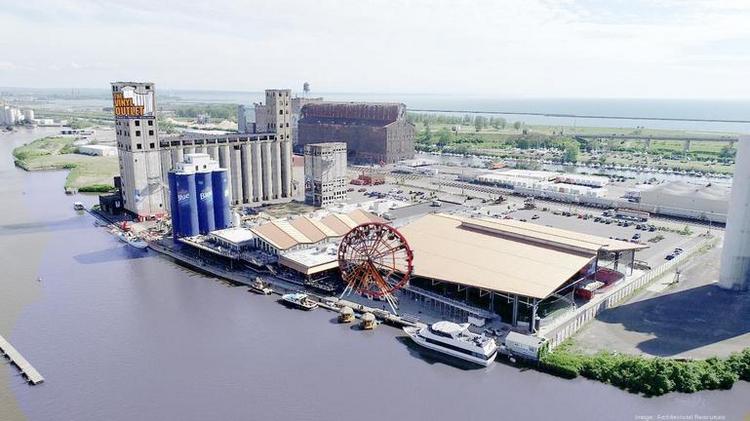
The proximity to Riverworks builds in a great venue for game day activities, something that could be a real asset not only on game days but on days when other events are held at the stadium. The pair of venues would make for a mini-stadium district and the proximity to KeyBank Center and Sahlen Field would mean many of the city’s biggest venues are within walking distance of each other. Additionally, the existing grain elevator could make for an awesome backdrop for one side of the stadium. The grain elevator wouldn’t need to be integrated directly into the building but it could still function as a compliment to it as a projection screen on game days or as a permanent tifo of sorts if a large mural was added to it. Ganson would also make this a waterfront stadium, with one side hugging the Buffalo River, allowing for fans to arrive by boat if that was an option. Aesthetically, Ganson St. probably offers some of the coolest features for a stadium of this size. The combo of the grain elevator, the river and views of downtown could give some similar vibes to Pittsburgh’s Highmark Stadium, though not quite as dramatic. It would become a great addition to the riverfront (and the overall waterfront by extension) as it will be a stone’s throw from the DL&W redevelopment and just across the river from the apartments built on Ohio St. The space should also be fairly available as this was previously eyed to be the home of OnCore Golf’s TopGolf-style project. I think it would be easy to get past the challenges of a lack of on-site parking given the other benefits this would offer.
The Cobblestone District
Given the sea of parking lots begging to be developed and the immediate proximity to Canalside and the arena, a Cobblestone District stadium is probably the most ideal location for the Buffalo USL stadium. Plugging a stadium in down near the arena would serve as the consolation to missing out on the new Bills stadium that The Buffalo News referenced in their coverage and would serve to create a proper arena district with KeyBank Center and Sahlen Field. It would also plug a big hole in one of the prime areas of development downtown.
There’s no shortage of spots to select in Cobblestone either. The arena lots bounded by Perry and South Park would help to complete the street wall along Perry and it would be the closest possible location to the new DL&W Metro station. That would be a cozy location nestled between the existing block of Cobblestone (Mississippi and Illinois) and the strip of buildings that face onto Michigan. There is also the expansive HSBC Atrium lot and the lots at Perry and Michigan that could be strung together for a site. That would be a little messier since Douglas Development has purchased the Atrium and has long term plans for the lot, while Uniland owns one of the Michigan lots. But, if an agreement could be reached on carving out a parcel, a stadium could be built along that block of Michigan and Perry and serving as a front door to the eastern end of the Cobblestone District.
Ease of access is a major benefit to a site in this area, much as it is for the arena. It’s also an area of the city that’s inching ever so closer to being a bustling district. Construction on the North Aud Block is right around the corner and Sinatra’s Canalside apartments are progressing. Douglas Jemal now owns the HSBC Atrium and The Buffalo News buildings and Benderson has been cleared to take over the East Canal Block across from Harborcenter. Jemal’s plans for the Atrium call for a parking structure which would allow him to add new development to the lot that stretches down Perry. Plenty needs to happen before all of that work is complete, and but a midsized soccer venue would make for a tremendous addition to the ongoing growth in this portion of the city. Plugging a stadium-sized hole in the numerous available parcels may even make it easier for this district to feel “complete”.
It’s a tantalizing prospect to think about and will make the future announcements from the group bringing the USL to Buffalo that much more exciting.
 Two in the Box
