Lindy Ruff has settled into a clear goalie rotation since the Sabres have returned from the Olympic break. Colten Ellis hasn’t started a game since February 3 and with the exception of Tuesday’s game against the New York Islanders, Ukko Pekka Luukkonen and Alex Lyon have traded on and off over the last 18 games.
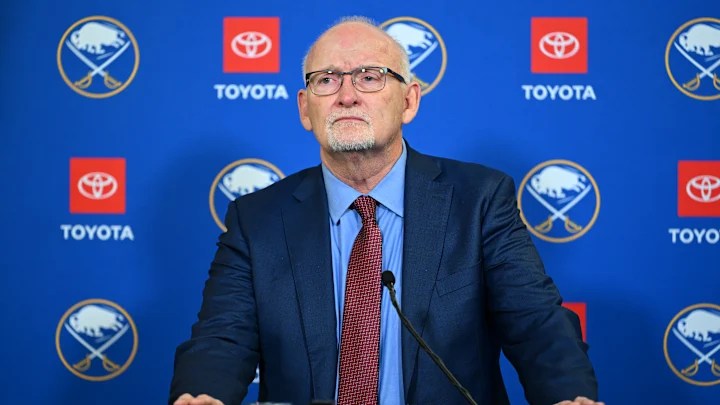
While the rotation has served the Sabres well, it has raised questions about how Lindy Ruff will opt to use his goaltenders once the playoffs begin. While more teams have shown a willingness to use multiple goalies in a playoff run, we’re still waiting to see a team fully commit to a proper rotation. That creates a challenge for the Sabres who are on track to end the season with a near even share of games played by Luukkonen and Lyon.
The rotation the Sabres have settled into has been beneficial to them as they’ve stacked wins after the Olympic break. Ellis has been locked in as the nightly backup, allowing one of the starting tandem to have an entire day to rest ahead of his next start. Luukkonen and Lyon have appeared to benefit from the extra rest, with the tandem landing among the league leaders in several categories including raw save percentage and GSAx on the season. Snapping last week’s losing streak has helped earn Luukkonen the first back-to-back starts for a Sabres goaltender since February 2. It’s clear Ruff has grown comfortable with the rotation and it will be interesting to see how quick he is to return to it depending on the outcome of Tuesday’s game.
Even though there are only eight games to play, it’s hard to say if starting Luukkonen is a nod to how Ruff will want to manage his goaltenders in the playoffs or if he’s simply rewarding Luukkonen’s strong play from Saturday and trying to ride the hot goalie. There are lessons that can be learned from Ruff’s history that may help paint the picture for Buffalo’s postseason goaltending rotation.
One of the hallmarks of Ruff’s career has been the consistency he’s enjoyed in net. With the exception of his time in New Jersey, Ruff has had the luxury of a bonafide, reliable starting goaltender for the majority of his coaching career. He was fortunate to step into his first head coaching job with the best goaltender in net. After four years of Dominik Hasek at the peak of his powers, Ruff rode Ryan Miller for seven full seasons, and had Martin Biron for the four years in the interim between Hasek and Miller. Kari Lehtonen wasn’t a world beater, but he gave Ruff fairly consistent results during the coach’s years in Dallas.
That consistency allowed Ruff to maintain a traditional 1-2 timeshare for the vast majority of his career, as was the leaguewide norm in those seasons. There have only been four complete seasons when Ruff didn’t have a goalie hit the 50-game mark while his starter played 60 or more games across 11 different years. That shouldn’t be a complete surprise, especially for a coach who had Hasek and Miller for a combined 12 seasons. Either way, the continuity in net made things easy for Ruff when it came to determining a playoff starter. He won’t have that luxury this year.
There is an outlier season that could provide some guidance for how Ruff could operate in the postseason. In 2015-16, Ruff had Lehtonen and Antti Niemi in a timeshare for the Stars. Niemi started 43 games while Lehtonen started 39. Their counting stats aren’t much to write home about, but the tandem helped the Stars to first in the Western Conference and second in the President’s Trophy race. There have been other years where Ruff was forced to rotate his goaltenders more consistently, but 2015-16 was the one year (prior to this year) when he did so without the added influence of injuries, poor play or other factors.
Ruff didn’t completely abandon the rotation once the playoffs began, but he didn’t stick to a rotation of every other game, either.
Lehtonen opened as Dallas’ starter for the 15-16 playoffs and won his first two games in the Stars’ series against Minnesota. After losing game three, he was replaced by Niemi. Niemi won game four but lost game five, allowing Lehtonen to return to clinch the series in game six. Lehtonen would start games one and two against St. Louis, but only lasted 20 minutes in game two after allowing three goals on five shots. In a similar fashion to the first round, Niemi got the net in the following game, but he also got the hook early in a 6-1 loss. That effectively ended Ruff’s experiment as Lehtonen started the remaining games, alternating wins and losses until the Blues closed out the series in game six.
It’s not a lot to work on considering it’s the one time Ruff entertained any sort of a proper rotation. He alternated his goaltenders a bit in 2022-23, but largely rode Akira Schmid after Vitek Vanacek had two poor outings to open the first round. The overwhelming preference of Ruff’s coaching career has been to pick a starter for the playoffs and stick with him. That leaves 15-16 as the closest comparable to the 2025-26 Sabres in Ruff’s coaching tenure. Could he revert back to that model? It’s a risky proposition if he does.
Swapping goalies after every loss, in a playoff series adds a new level of pressure to an already pressure-packed situation. No two players will handle pressure the same way, so it’s unfair to put every goalie in the same bucket. Still, the process Ruff used in Dallas creates a scenario in which Buffalo’s goalies would be operating under an additional layer of stress.
Ruff isn’t the first coach to search for an answer after rotating goalies in the regular season. Carolina has struggled to maintain the effective rotation they’ve used in the regular season over the last several years. Similarly, Boston opted to lean on Jeremy Swayman in 2023-24 after he and Linus Ullmark effectively split duties in the regular season. This is hardly a new struggle, especially as NHL teams continue to favor timeshares over a more traditional 1-2 rotation in net.
How Ruff proceeds over the final three weeks of the season ought to help paint the picture for how he’ll operate in the postseason. Not only did Ruff give Luukkonen the start on Tuesday, he plugged Lyon in as the backup, marking two shifts in their behavior since returning from the Olympic break. There’s not nearly enough to go on yet, but it’s a start.
 Two in the Box