Overthought is a semi-regular series that takes a look at some of the more interesting and notable tidbits shared by Elliotte Friedman in his weekly 32 Thoughts column. Each edition will feature some unique thoughts on the state of the Sabres or league as a whole before digging in on some of the notes from Freidman’s weekly column.
History repeated itself, as Devon Levi was sent to Rochester earlier this week, not far off from his initial demotion last season after a similarly rocky start to the season.
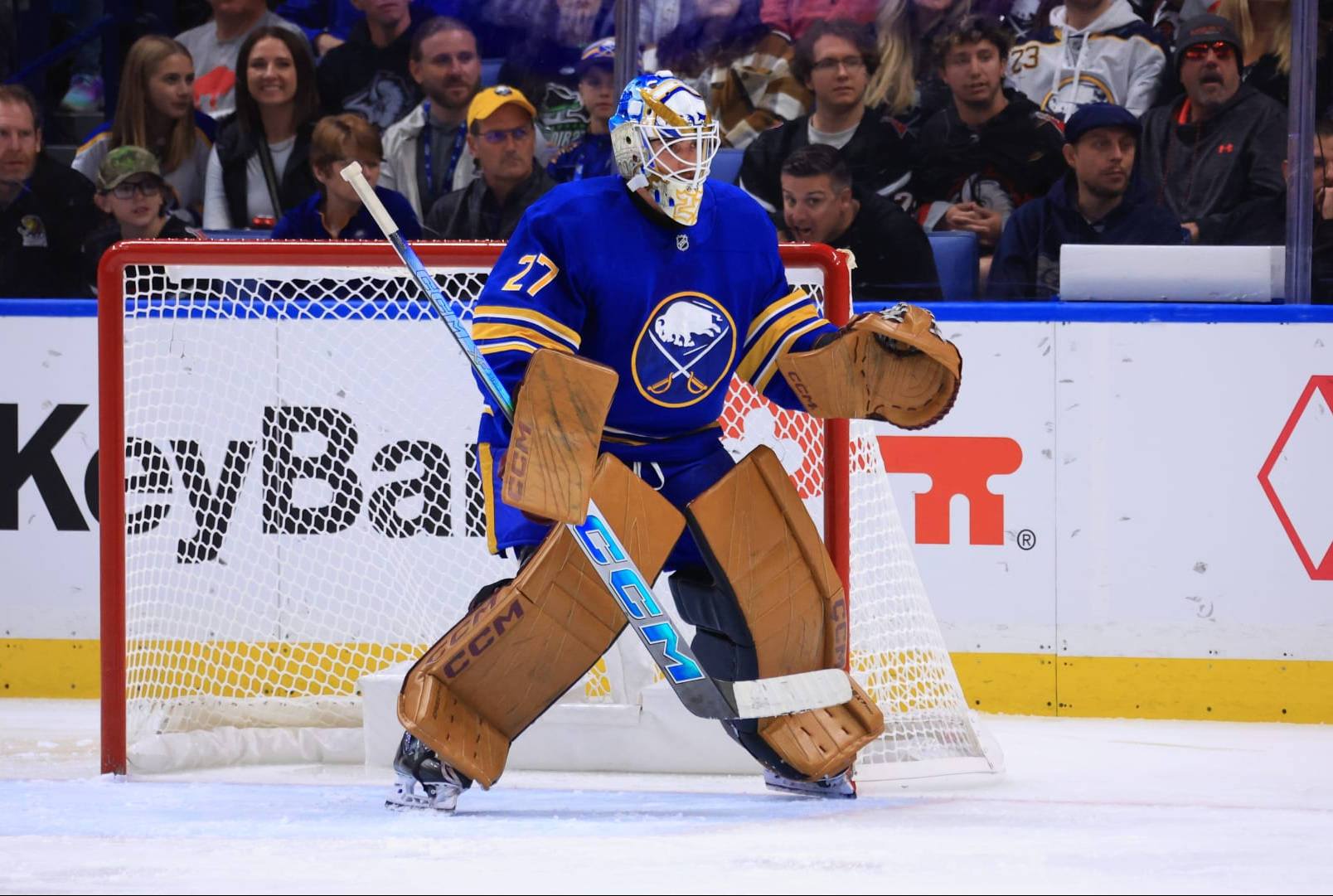
Like last year, the choice to send Levi down is sound. His play wasn’t up to an NHL standard and the Sabres risked bleeding points with every game Levi started. This isn’t a sign of defeat for Levi, however. At 22 years old, he has a lot of runway before any definitive proclamation about his career can be made. He has only played 63 professional games and he will benefit from an increased workload in Rochester; another benefit he enjoyed last year as well.
If the Sabres have made any error with Levi, it has been expecting too much of him too soon. He was steady in his initial seven-game cameo in 2022-23 after signing his entry level contract, but his consistency has waned since. Few, if any, goaltenders are capable of stepping into a full time NHL job from NCAA or junior. Those that have are either developmental exceptions or have had to work their way through regression in their play as teams and shooters have adjusted. Levi appears to be more the rule than exception when it comes to his development track.
It was popular to talk about how Levi’s NCAA career numbers were better than everyone other than Connor Hellebuyck and Ryan Miller (guilty) and I think that likely played into some of the expectation that he could jump right into an NHL job. As has been pointed out by many, Ryan Miller was able to bide his time in the AHL before stepping into the Sabres crease full time. But I think the two best examples fans (and the team) should have been looking to are Dustin Wolf and Joey Daccord. Both are seventh round picks and NCAA products and they each saw extended AHL time before earning their NHL jobs. Daccord had a slightly altered path as he was a taxi squad player post-COVID, but overall, he has 98 AHL games under his belt. Similarly, Wolf was given the reins for Calgary’s farm club over the course of three years, allowing him to rack up 141 AHL games before this season. If you’re looking for another common thread, Wolf is only 23, just a few months older than Levi.
A full AHL workload would be hugely beneficial for Levi, I have seen a fairly stark difference in Levi’s play with the Sabres compared to his time at Northeastern. Even looking back at those first seven games he played, Levi was far more patient and confident in holding his edges and diagnosing plays. There were certainly areas of his game that needed to be cleaned up, but he had the same air of confidence that made him so dominant at Northeastern and his supreme skating ability and hockey IQ was paying off. Many of those traits haven’t been present over the past year. Levi doesn’t appear to be nearly as patient with his footwork, playing with very active feet that, at times, have pushed him out of position on saves. Many have contended that he has been playing too aggressive and I don’t fully agree with that sentiment. I think his issue has been being overactive in the crease but not necessarily overly aggressive. To better illustrate that, think of the number of plays where he is sliding out of the crease or getting beat on white ice as opposed to plays where he has made a save but has slid away from the rebound or where the initial shot came from. I’ve noticed far more of the latter than the former. He’s also struggled a bit with traffic to my eye, another thing that could be worked out with more repetition.
Should Levi remain in Rochester for the duration of the year (save for any spot starts they care to get him), the next point of debate for him would be whether or not he should be seen as the presumptive partner for Ukko-Pekka Luukkonen next season. That’s a long way off of course, and if Levi puts up another .927 for the Amerks this year, he’d certainly be the clubhouse leader for that job. However, he’d likely fall in the neighborhood of about 60 total AHL games played. I have to wonder if something closer to 100 AHL games would be the ideal target for him. It’s worth watching as the season progresses to determine if his play is strong enough to justify another look, or if the Sabres will target another veteran for Luukkonen to partner with in order to give Levi more time to grow next year as well.
3. Weird idea that may only make sense to me: Nikita Zadorov back to Vancouver. No idea if even possible, or if anyone would want it, but he was a good fit and the Canucks miss him.
I had a lot of reservations about what Zadorov’s next contract was going to look like after all of the positive press he received last year. I think he’s the sort of player who needs a pretty specific situation to succeed and overpaying and overplaying him could be a recipe for disaster for whoever signed him. It appears that the Bruins are dealing with this now, they’d probably welcome the opportunity to sneak out from under this contract.
5. Nashville’s three first-round picks in 2025 (Tampa Bay and Vegas, in addition to its own) are coveted by teams they talk to, but GM Barry Trotz so far shows no indication to move them. In addition to a centre, he’s also looking for a top four defender with a bit of term.
Congratulations to Barry Trotz for joining the group of about 28 other general managers who are also looking for a center and top four defender with term. I’m no fan of unrestricted free agency but I’m still amazed that things have gone so sideways for the Preds. I figured Jonathan Marchessault would be a nice fit there and that you knew what you’d be getting out of Steven Stamkos. Trotz is in an advantageous position with those extra firsts in their back pocket, I’d probably try to shop at least one of them pretty hard in the next month or so in order to get some immediate help.
File this under random thoughts as I don’t see a trade fit overall, but if the Sabres were ever to shop Dylan Cozens, I think Nashville would be a logical landing spot. It should be noted that I don’t think the Sabres would have much appetite to be shopping Cozens, so bear that in mind.
7. Other notes down the middle: What complicates Christian Dvorak’s situation is he’s got too good a salary in 2024-25 — $5.75M ($4.45M cap hit). When that comes down as the season progresses, we will see where things stand.
I know the Sabres could be in the market for one more center, especially if Cozens gets shifted to wing on a more permanent basis, but miss me with any suggestion that Dvorak would be a target. I’m still firmly of the belief that if the Sabres are adding to their forward group, a winger that fits into that top/middle six role is the best option to be pursuing.
15. The FAN Hockey Show hosts Matt Marchese and Mike Futa asked if U.S.-born Joey Daccord could play for Team Canada. His father is Canadian. Even more interesting: his mother is Swiss, and that country’s asked about his Olympic availability. As of Tuesday, Team Canada had not asked the NHL about using him in the 4 Nations. For that tournament, it would depend on which passport he carries. Good question, though.
If I’m running Team USA, I’d strongly consider bringing Daccord as the third goalkeeper. For one, that move (if Daccord was amenable to it) would add a bit of chaos and spice to the 4 Nations Faceoff, which I think would be a nice little wrinkle. Secondly, Team USA’s first two goaltenders are pretty well set in stone. Connor Hellebuyck is going to be the starter given how stellar he’s been all season and Jake Oettinger is a lock to back him up. However, Jeremy Swayman has dealt with a rocky start to the season and Thatcher Demko’s injury will likely keep him out of any serious conversations. Daccord might be the third-best option on merit alone. But that third goaltender spot could be used as a reward of sorts for an American netminder the USA Hockey braintrust wants to acknowledge for their strong play. Daccord has enjoyed the fruits of a committed development track and a spot at the 4 Nations would be a fine reward for those efforts. And on top of all of that, bringing Daccord as the third goaltedner would prevent Canada from shoring up what is clearly their weakest position.
20. Other issues presented to me: a few players and agents worried that it was too early to present this scenario to the group — don’t count your chickens until they’ve hatched — while a couple of governors wondered how many teams could really handle a $110M cap and how much more revenue they could squeeze from their buildings. (Wednesday on CNBC, Bettman discussed upcoming Canadian media rights, saying the league’s triggered a 60-day window to negotiate with Rogers. It opens Jan. 1.) Several sources — knowing the players’ hatred of escrow — asked if they’d truly risk such big salary cap jumps. Escrow got as high as 22 per cent in the past, no way they’d want to go back there. So there’s a lot to unpack. But it’s a conversation that will come as part of CBA discussions.
This note got my wheels turning on a topic that I haven’t seen discussed much with respect to the salary cap and the cap floor. At what point does the NHL reach a cap ceiling that clubs aren’t comfortable going to? And if they reach that point, does the league begin to sort into the haves and have-nots of the pre-cap era?
Friedman gets at it a bit with the revenue point, as there are already “budget” teams in the NHL. If the cap continues to skyrocket, is there not a threat that the Maple Leafs and Rangers of the world will be willing to spend to that limit while lower revenue clubs opt to operate closer to a $95 million payroll or less? The Coyotes were effectively a dead cap laundering service the last several seasons, but they certainly had the look of a club that wouldn’t touch the top end of a $110 million cap. The Sabres are cruising along with a cool $7 million in space and have appeared content to spend below the league’s upper limit for some time now. Is it not logical to assume clubs in that boat would continue to operate to a similar financial standard? And if that’s the case, would there need to be conversations about adjusting aspects of the cap to preserve the parity the league is seeking with this system?
 Two in the Box