Ukko-Pekka Luukkonen is armed with a fresh five-year contract after a breakout performance in 2023-24. He’s locked in as the Sabres starting goaltender for the foreseeable future after taking a firm grasp on the job when neither Devon Levi or Eric Comrie could.
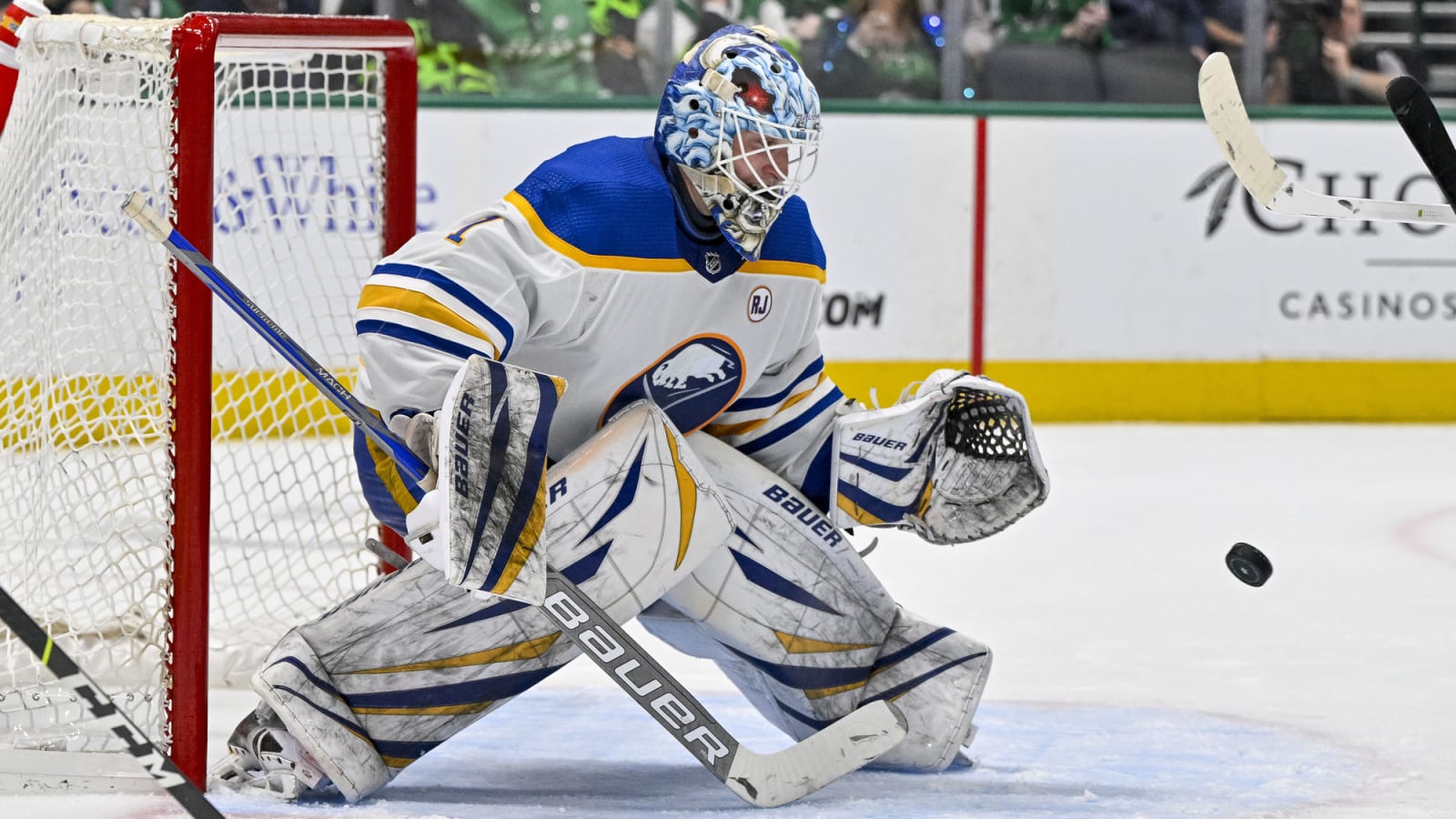
Luukkonen was a steady, effective presence for the Sabres last season. He posted a 22.46 GSAx (according to Evolving Hockey) with a healthy .910 save percentage. His play was so strong that it helped to counterbalance Buffalo’s offensive struggles. That they even had a sniff at the postseason was a testament to Luukkonen’s stellar play.
He was also tasked with a fairly heavy workload. Only 10 goalies played more than the 54 games Luukkonen appeared in and he was effectively the only goaltender the coaching staff would turn to as their lack of faith in Comrie was evident. Even with Levi carving out 23 appearances, his games came in chunks with lengthy, necessary spells in Rochester in between. In virtually every aspect, Luukkonen was Buffalo’s MVP in 23-24.
Yet, his coming out party was something of a surprise. His play at the NHL level prior to last season was at the very least, inconsistent, and at times, substandard. Luukkonen’s best spell would have been in 2021-22 when his numbers in Rochester were respectable, though hardly outstanding, and he posted a .917 SV% in a nine game cameo. But a combination of average play in the minors and shaky appearances at the NHL level (.892 SV% in 33 games in 22-23) left Luukkonen’s stock quite low. He deserves a mountain of praise for getting his game to a place where he could be as effective as he was this past season.
Among his biggest issues, especially in 22-23, were puck tracking and diagnosing plays. He’d often put himself in difficult situations where he was forced into desperate, reaching saves that left him exposed for rebounds or simply opened up a lot of the net. In many cases he was just leaky. Whether it was poor angles, poor tracking or some combination of the two, it wasn’t uncommon to see Luukkonen beat on a clean shot that should have been an otherwise routine save. He’s not the first Finnish goalie to play with a more compact stance despite impressive measurables, but his tendency to “play small” often got him in trouble.
By comparison this past season, he was much better utilizing his size when bearing down on shooters. He cleaned up the leaky goals from his game and that went a long way towards his resurgent play. The following video clip illustrates some of the leaky goals he allowed in 22-23 and follows with a collection of saves from this past season. Please note that the situations aren’t carbon copies of one another, so the saves and goals against aren’t meant to be direct comparisons, but an illustration of the areas where Luukkonen struggled previously and where he improved this past season.
Maybe the best set of clips in that collection are the juxtaposition of the two goals scored by the Flames compared to the last clip, a save on Adrian Kempe. While the two Flames goals were open looks where Luukkonen didn’t seem to get well set on his angle as the puck carrier was moving, he is well set as Kempe gathers the puck off a transition turnover and he makes the save look routine.
Perhaps the area where Luukkonen improved the most was in his ability to maintain good posture and technique in net, especially when going side-to-side. In prior years he would tend to fall forward, with his chest pointing down towards the ice, if not touching the ice, when attempting to make a save moving from one post to the other. Or from higher in the crease to his back post. His struggles to keep his upper body upright on these plays left him vulnerable to pucks shot up high as his chest and sometimes his hands were on the ice. Some of this could have been caused by poor technique and some could be traced to not making the proper read on a play and needing to overcommit to a desperate save when the puck was moved. There’s not one, distinct cause of that issue, but it cropped up a fair bit on him in prior seasons.
It’s also not something that would be totally erased from any goalies’ game. The NHL is a fast league and sometimes situations dictate a desperate save, or a bad bounce leads to a goalie needing to stretch a little extra for a save. There were still plenty of occasions where Luukkonen found himself nearly flat on the ice with his legs outstretched this past season. The issues crop up if the technique is overused or even appears to be a default reaction in net. And I think this is an area where Luukkonen really cleaned up his technique, tracking and reading of the play.
This next video compiles several more clips of Luukkonen from the past two seasons where you’ll see instances where he overcommitted to the puck carrier and was unable to recover. On the comparable saves, you’ll see Luukkonen is sharper reading the play and is able to make saves on both dekes and passing plays with good posture where his hands are upper body are still in play.
The first goal in this clip is especially informative. Luukkonen freezes on Dillon Dube’s pass, almost reacting like a shot, forcing an awkward, attempt to get across. He ends up in a quasi-push up position as the puck gets behind him. By comparison, in the next clip he’s in an RVH as the puck comes across to the far side but he makes the save upright. He’s not reaching or falling forward. Like the initial collection of clips, these are precise one-to-one comparisons but the difference in how he reacted to each play is notable. He shows a similar issue in the Carolina goal where he freezes on Martin Necas and is late coming back across. Even on the save against Calgary from 22-23, you can see how far forward he winds up despite making the stop.
I also found the one on one clips to be insightful. The plays are obviously significantly different (shootout vs. a pass from behind the net), but the difference in how he plays each situation is drastic. Against the Hurricanes both hands wind up on the ice after he’s pulled out of position. Against the Oilers he stays poised and patient and doesn’t lunge at either puck carrier, using his size as an advantage.
You can mine his games from 23-24 for countless other examples of where his play improved. There were a dozen other clips I had flagged before cutting to this shorter collection. There is no doubt that the spike in his counting stats and underlying numbers was rooted in improved technique. You didn’t see him frozen by a puck carrier like in the second set of clips and his ability to use his length gave him an edge in so many of his starts. He was sharper and far more consistent than at any other point in his professional career. That foundational improvement should provide optimism for his ability to continue that upward trend.
There is no doubt there is potential for Luukkonen to backslide. One of the most obvious comparables for his new contract, FIlip Gustavsson, was a shadow of himself this past season. Giving Luukkonen five years is a bit of a gamble. If he doesn’t maintain his level from this past season, those last few years could be particularly painful. We’ll see how he handles a full season of expectations as a starter, with 50-plus games of additional tape for shooters to study.
For now, his improvement is what matters most. Luukkonen took a huge step for the Sabres last season and now he’s being paid accordingly. Stacking improvement on the building blocks of what made last year a success is the next step for the young netminder.
 Two in the Box